• Trendlyne logo
  • Markets
  • Superstars
  • Analyst Estimates
  • Alerts
  • Screeners
  • Subscribe
  • Calendar
  • ETFs
  • Portfolio
  • Watchlist
  • Insider Trades
  • Results
  • Data Downloader
  • Events Calendar
  • Explore
  • FAQs
  • All Features
  • Widgets
More
    Search stocks
    IND USA
    USA
    USA
    IND
    USA
    • Stocks
    • News
    • Fundamentals
    • Reports
    • Corporate Actions
    • Alerts
    • Shareholding

    The Baseline US

    0
    Stocks Tracked
    0
    Sectors & Interests
    Follow
    logo
    The Baseline US
    19 Jun 2026
    Mega IPOs deliver a windfall for US investment banks

    Mega IPOs deliver a windfall for US investment banks

    More people than usual are talking about the SpaceX IPO, because of its eye-watering valuations and the Elon Musk connection. Matt Stucky, Chief Portfolio Manager at Northwestern Mutual Wealth Management, says he has "never been asked more about an IPO" by clients and advisers.

    Wall Street had a field day with the deal. The banks underwriting the IPO took home about $500 million in fees, despite settling on just 0.7% of the proceeds. That fee pool alone was about the same size as Goldman Sachs' equity underwriting revenue for the first quarter.

    No wonder Goldman fought hard for the mandate. CEO David Solomon had apparently slid into Elon’s DMs on X around May, to discuss the SpaceX listing. Back in 2007, Solomon had won the Lululemon IPO deal by showing up to the pitch meeting dressed top to toe in Lululemon gear.

    SpaceX Tweet

    After a prolonged dry spell in the IPO market, this mega-listing has given bankers a win. IPO activity has been subdued since the 2021 boom; higher interest rates and economic uncertainty have kept many acquisitions and fundraising plans on hold.

    But 2026 is already buzzing. Global M&A volumes have crossed $2.6 trillion this year. Companies are growing more confident about making long-term investments. Goldman Sachs investment banking co-head Matt McClure says that "CEOs and boards are taking a long-term strategic view" despite the uncertain macro environment.

    The IPO market is reopening, led by AI

    SpaceX has dominated the headlines, but bankers are also looking at the next wave of companies preparing to go public.

    OpenAI and Anthropic have confidentially filed for IPOs, while several other AI companies are exploring public listings. Together, the known AI pipeline could raise more than $150 billion. That is roughly five times the amount typically raised through US IPOs in a normal post-pandemic year.

    AI IPO Pipeline

    Wall Street is seeing dollar signs beyond just IPO fees. The companies preparing to list are among the biggest spenders in technology. OpenAI has said it expects to spend about $600 billion on AI infrastructure by 2030, while AI companies across the industry are raising money for chips, data centres and acquisitions. Funding ambitions of this scale can create years of dealmaking opportunities for investment banks across the AI ecosystem. 

    Established tech players are also ramping up spending on AI infrastructure. Since 2025, firms like Alphabet, Amazon, Meta, and Oracle have already raised over $270 billion by selling investment-grade bonds.

    Nvidia recently joined the AI fundraising wave, returning to the bond market for the first time since 2021 with a $25 billion offering. Investors have absorbed similar debt sales from technology giants, giving banks more opportunities to earn fees from bond offerings.

    M&A activity spreads beyond AI

    Bankers have spent the last few years talking about a recovery in dealmaking. But rising borrowing costs, market volatility and cautious corporate boards delayed that comeback.

    The difference this year is that more deals are actually getting done. Global M&A deal values rose 27% in early 2026 and reached their highest level in five years. Technology remains a major driver, but activity is also picking up across healthcare, consumer businesses and industrial companies.

    M&A Activity Chart

    One deal drawing particular attention is the proposed buyout of Electronic Arts. JPMorgan is arranging roughly $20 billion in debt financing to help fund the acquisition. When a single transaction requires that much capital, the fee pool becomes huge for the banks involved.

    The recovery is starting to extend beyond the largest and most closely watched deals. Recently, Evercore CEO John Weinberg stated that deal activity is broadening into the middle market.

    Investors have become more willing to back new deals, but they haven't stopped scrutinizing them. Alex Robb of Ropes & Gray said there remains "robust appetite for new debt deals", though companies with weaker finances are still finding it harder to attract investors.

    That became clear earlier this year in a financing deal linked to fantasy sports company PrizePicks. Banks expected investors to buy most of the debt tied to the transaction. But interest for the debt package came in below expectations, forcing the banks to hold a larger share of the debt themselves.

    The house always wins

    JPMorgan generated $2.9 billion in investment banking fees during the first quarter, up 32% from a year earlier. Goldman Sachs reported an even larger increase, with investment banking fees rising 48% to $2.8 billion.

    Thanks to rising deal activity, shares of Goldman Sachs, Morgan Stanley and Citigroup have surged over 20% since the start of the year. Citigroup also outperformed its peers after President Donald Trump lauded the bank and its CEO, Jane Fraser, in a recent Truth Social post. This comes after a weak performance in its investment banking division over the past few quarters. However, Citigroup CFO Gonzalo Luchetti expects revenue from the investment banking business to grow in the mid-teens in Q2.

    Goldman Sachs helped lead SpaceX's IPO, advised Dominion Energy on its $66.8 billion sale to NextEra Energy, and worked on more than $1 trillion worth of announced M&A transactions this year. JPMorgan remains one of the busiest players in the market, helping finance some of the largest buyouts currently under discussion.

    The SpaceX deal offers a glimpse of why these mandates matter so much. Goldman Sachs and Morgan Stanley each walked away with roughly $100 million in fees, while Bank of America, Citigroup and JPMorgan Chase earned about $75 million each.

    As long as companies keep raising capital, pursuing acquisitions and coming to market, the flow of fees continues. For investors, the larger question is whether the stock will perform after the deal is done.

    Analysts at JPMorgan recommend buying Goldman Sachs and Morgan Stanley ahead of Q2 results next month. They argue that “markets may be underestimating how much recent IPOs, financing activity and trading volumes could boost their results.” The bankers are right now, making bank. 

    Copy LinkShare onShare on Share on Share on
     
    logo
    The Baseline US
    05 Jun 2026
    Bond markets force America to live with higher rates

    Bond markets force America to live with higher rates

    Two weeks from now, Kevin Warsh will chair his first Federal Reserve meeting. With bond markets already signalling that interest rates are not coming down, the timing for the new Chairman couldn't be worse.

    The US-Iran conflict has pushed gas prices above $5 a gallon in many states, bringing inflation fears back and driving the 30-year Treasury yield above 5% for the first time since 2007. Just a few months ago, Wall Street was pricing in several rate cuts this year. Now, the debate is whether the Fed’s next move will be another rate hike.

    It wasn’t just oil and the US-Iran war that changed the story. The American economy has not slowed as expected, and this has weakened the push for a rate cut. Retail sales have repeatedly beaten forecasts. Delta Air Lines recently said that summer travel demand remains “quite healthy” despite concerns around consumer spending. The private sector is spending heavily as US tech companies scramble to buy chips, power capacity, and data center space as AI investments surge.

    Trump picked Warsh in part because markets viewed him as more dovish on monetary policy. But despite Trump’s fondness for interest rate cuts, he insisted at Warsh’s swearing-in ceremony that the new chair is "free to do his own thing”. Traders are interpreting that as a signal that policy could remain tighter for longer.

    Traders stop betting on Fed cuts

    Analysts no longer believe inflation will cool enough to justify cuts anytime soon.

    Before tensions in the Middle East escalated, inflation had fallen from its 2022 peak. Under normal circumstances, Treasury yields should have gradually fallen alongside it. Instead, the benchmark kept climbing as bond buyers grew concerned that the economy remained stronger than forecast.

    The labor market still looks unusually resilient for an economy with financing premiums above 5%. Consumer spending is holding up better than anticipated. Employers are hiring. Even industries that analysts expected to weaken first, like travel and entertainment, are reporting solid demand.

    Then came the artificial intelligence spending boom. Markets increasingly view this less like a software trend and more like an industrial expansion cycle. Microsoft, Amazon, Alphabet, and Meta are collectively spending hundreds of billions of dollars building data centers, securing power supply, and expanding computing infrastructure. That spending has impacts far beyond just Silicon Valley, in a construction, utilities, metals, and industrial equipment boom.

    Bloomberg’s Joe Weisenthal recently wrote that the rising 10-year benchmark means “a whole range of borrowers will face steeper prices, from homebuyers to data center builders.”

    For most of the post-2008 period, Wall Street spent its time worrying about weak growth, weak inflation, and weak demand. Now markets fear the opposite problem: an economy that may stay too strong to allow borrowing costs to fall.

    America’s debt is looking expensive

    For years, investors weren’t too worried about America’s debt burden because interest rates stayed near zero.

    During the pandemic, the government borrowed trillions of dollars at extremely low levels. Now, as Treasury yields cross 5%, much of that debt now needs refinancing at far greater premiums. The Congressional Budget Office projects federal interest obligations to rise from 3.3% of gross domestic product in 2026 to 4.6% by 2036 as the government refinances older debt.

    That would make interest payments larger than many major government programs, and eat into the government’s ability to push for new projects and initiatives.

    Like compulsive borrowers, governments can also fall into debt traps. This rising rate environment can feed on itself. Swelling deficits force the government to issue more Treasuries. More Treasury supply pushes borrowing costs upward, which further bloats the deficit and forces the government to issue even more debt.

    Jamie Dimon recently warned that rates could move “much higher” because fund managers are questioning how much government debt markets can absorb without demanding greater compensation.

    Bond buyers are also becoming less confident that inflation will remain predictable over long periods. That uncertainty matters because buyers of 10-year and 30-year Treasuries increasingly want protection against the risk that inflation stays higher for longer than central banks expect.

    Rising rates hurt consumer confidence

    Bonds don’t have a hold on people's imagination compared to say, a Knicks game. It’s not going to dominate dinner-table conversations. But they are fundamental to some of the biggest financial decisions Americans make.

    Millions of homeowners refinanced mortgages below 3% during the pandemic. Today, the 30-year mortgage average sits close to 7%. For many families, moving today means assuming monthly payments hundreds or even thousands of dollars larger than their current obligations.

    So people have delayed moving, builders are slowing down projects, and higher rates are increasingly pricing new buyers out.

    Existing home sales in the US are well below pre-pandemic levels, even though the broader economy continues to grow. “The housing market is stuck,” Redfin recently noted while describing how homeowners remain locked into older cheap mortgages.

    The pressure spreads far beyond housing. Credit card interest rates remain near record highs. Auto loans have become significantly more expensive. Businesses now think more carefully before borrowing to expand or hire workers.

    Consumer confidence has crashed as borrowing costs and inflation weigh on household finances. The University of Michigan’s Consumer Sentiment Index fell to 44.8 in May, marking the lowest reading ever recorded and reflecting growing concerns about the cost of living and future inflation.

    The stock market has managed to absorb much of this pressure because profits from large technology companies are surging alongside artificial intelligence spending. Since early 2023, the S&P 500 has hit new records even as Treasury yields climbed relentlessly upward.

    Historically, though, those two trends rarely coexist for long.

    Once government bonds start offering 5% returns with relatively low risk, stocks are a lot less seductive. Investors become less willing to pay extreme valuations for stocks whose profits may arrive years into the future. That becomes especially relevant for expensive technology companies that have led much of the market rally.

    For now, earnings growth continues to mask some of that pressure. But bond markets are flashing warning signs about the tightrope we are on.

    Copy LinkShare onShare on Share on Share on
     
    logo
    The Baseline US
    22 May 2026
    US homebuyers waited out the frenzy, but there's no relief in sight

    US homebuyers waited out the frenzy, but there's no relief in sight

    Are you planning to buy a home this year? After years of brutal bidding wars and record-low inventory, 2026 was supposed to be the year when most people could land a home, as supplies grew.

    Unfortunately, the pain continues. Rising mortgage costs and economic uncertainty have created a different kind of housing slowdown.

    Home improvement retailer Lowe's recently joined its rival Home Depot to highlight a squeeze in the US housing market. High oil prices are driving up shipping costs just as shopper confidence hit record lows. And 10-year treasury yields, a benchmark for mortgage rates, rose to hit a 16-month high on May 19.

    The real estate market sure looks busy. New construction "hit its strongest level since December 2024” in March. But look closer, and the smiles are strained. Yes, construction activity rose 10.8%, but permits for future projects fell. Single-family permits dropped 3.8%, hitting their lowest level since August 2025. This matters because permits reveal what builders expect for the coming months.

    Why has the mood darkened? One reason builders are getting nervous is that high borrowing costs are scaring off buyers. Lowe’s CEO Marvin Ellison said, “We are operating in a K-shaped economy where the higher-income consumers are spending on home upgrades, while the lower-income consumers are a little bit more uncertain.” Homes are sitting on the market a lot longer. 

    Tudor, classic, midcentury?: there are now plenty of homes, but few are buying

    For the first time in years, the US housing market is loosening up. Listings are rising, open houses are not as crowded. But sellers are being forced to cut their prices, as the spring buying season struggles to gain momentum.

    Sellers now outnumber buyers by roughly 43%, one of the biggest gaps in more than a decade. In a normal market, that would lead to a pickup in transactions as buyers get room to negotiate. But buyers are choosing to wait.

    Affordability has become the biggest obstacle. Buyers who spent the last two years waiting out bidding wars expected this spring to offer relief. But the monthly cost of ownership feels out of reach for many households. Pending home sales, which track signed home contracts before deals officially close, fell 1.1% YoY in March 2026, making it one of the weakest spring selling seasons in years.

    “The stage had been set for a good homebuying season,” Homes.com economist Brad Case said recently. “But being serious about buying a home doesn’t translate into actually buying it.”

    Mortgage costs jump as US-Iran conflict rattles markets

    The US war with Iran has shifted housing sentiment pretty quickly.

    Rising oil prices and inflation fears have pushed mortgage rates sharply higher. The average 30-year fixed mortgage rate climbed from below 6% in late February to above 6.2% within weeks, according to Freddie Mac. At one point in April, rates briefly touched nearly 6.5%.

    Even small moves in mortgage rates can dramatically change affordability for middle-income households. Buyers with carefully planned budgets are now priced out of homes due to higher rates. While some started searching for smaller homes, others delayed purchases entirely and chose to stay in rentals.

    Nic Parés, a 37-year-old IT worker in Austin, said he and his wife had to reduce their budget by nearly $100,000 after borrowing costs jumped again. “There are properties that probably check all of our boxes that we’re now priced out of,” he said.

    The pressure is especially severe for first-time buyers because nearly all of them rely on mortgages to purchase a home. Around 97% need financing, but smaller home loans have become harder to access. Banks earn far less from a $100,000 mortgage than from a much larger loan, even though the processing costs are almost identical. As a result, many lenders have stepped away from smaller-ticket lending.

    So while affordable homes still exist in cities like Detroit, St. Louis, and Memphis, especially on older lots, many buyers cannot secure financing to purchase or repair them. 

    Homes are staying on the market for more days than last year

    A typical US home now spends nearly two months on the market before finding a buyer. Back in early 2022, many homes barely lasted 30 days before getting snapped up. Now, even compared to last year, today’s market is noticeably slower.

    Texas real estate analysts say the “correction underway is a normalization, not a collapse.” Inventory has nearly doubled from levels seen during the 2021-2022 housing boom. 

    Residents are starting to notice the difference too. One Austin homeowner described how dramatically the mood has changed in just a year: “A year ago, ‘For Sale’ signs turned into ‘Sold’ signs before the weekend was over.” Now, many of those 'For Sale' signs are looking a little worn out, as winter turns to spring and the houses are still on the market.

    Copy LinkShare onShare on Share on Share on
     
    logo
    The Baseline US
    30 Apr 2026
    CEO exits surge as AI and activist boards shake up the C-suite

    CEO exits surge as AI and activist boards shake up the C-suite

    Most of the top companies in the US market have CEOs well into their 50s and 60s. Vast experience in navigating the industries they are in, have been key to their rise through the ranks.

    But the advent of AI brings up a different concern: how good are these older people in embracing new tech? As AI becomes a competitive advantage, CEO turnover is rising, as the top brass struggles to stay relevant.

    “If the person at the top can’t do it, they’ll find the next one,” says Georgetown University professor Jason Schloetzer, noting that there is growing assertiveness among boards and activist investors to push CEOs out. C-suite exits are reaching record levels. And pre-emptive firings seem to be catching on, as in many cases, companies are choosing to reset leadership even before the pressure shows up in earnings.

    “There’s a sense of planning behind many of these transitions,” notes Ariane Marchis-Mouren, Senior Researcher at The Conference Board. The shift from reactive firings to deliberate succession is becoming clearer.

    At Apple, Tim Cook is set to pass the CEO baton to an internal successor, John Ternus and move into a chairman role. Ternus has spent 25 years at the company, leading hardware across its core products. Reports suggest his first product roadmap will focus on the long-elusive foldable iPhone (a product that many competitors including Samsung have been selling for years) and a pipeline of AI-powered smart home devices and wearables.

    Early 2026 has several top executives stepping down or retiring. Many of these reflect the challenge of keeping pace with rapid change. CEO chairs are well-cushioned in more ways than one, and as Satya Nadella puts it, “success can make people forget the habits that made them successful in the first place.”

    New face for the next race

    Tim Cook at Apple, Doug McMillon at Walmart, Shantanu Narayen at Adobe: these CEOs have all led their companies for over a decade.

    During Adobe's March 12 update, Narayen noted it was his 100th earnings call as CEO, marking a tenure that saw revenue grow from under $1 billion to over $25 billion. Narayen helped move Adobe from a packaged software company to a cloud-first platform. But now, the winds of AI have been threatening to uproot some of Adobe's most iconic products, including Photoshop.

    Adobe says Narayen will step down as CEO, announcing the move even before the board found a successor.

    Narayen isn't an outlier. Of 234 global CEO departures in 2025, 32% were planned succession events, up from 22% a year earlier.

    Coca-Cola CEO James Quincey frames his departure as one “following waves of organizational momentum.” He notes that the company made strong progress in a pre-AI world, but the next phase requires "someone with the energy to pursue a completely new transformation of the enterprise."

    Former Walmart CEO Doug McMillon echoed this before stepping down after a decade. He handed the reins to John Furner in February, saying the role needed someone “faster.” McMillon added that while he could start Walmart's next shift into AI-led shopping and “agentic commerce,” he “couldn't finish” it.

    Not all CEO exits are the same

    When you hear that a bunch of CEOs are stepping down, it’s easy to assume the story is the same everywhere.

    Brian Cornell spent over a decade rebuilding Target, but over time, the stores lost some of what made them stand out. Sales stayed weak, and the in-store experience started to feel less distinctive. “In a world where we operate today, our guests continue to look for Tarzhay,” Cornell joked while announcing his departure. Consumers coined that posh, fake-French nickname for Target decades ago, to define how the stores supposedly elevated the everything-everyday shopping experience to something special.

    In other cases, company boards are also now more proactive, firing CEOs deemed ineffectual within the first two to three years. PayPal, for instance, raised its outlook twice during the year, then reported numbers that missed expectations. Within days, the CEO was out. Alex Chriss had been in the role for just over two years. The board didn’t soften the message: “The pace of change and execution did not meet the board’s expectations.” The stock fell as much as 18% before markets even opened.

    What is really changing?

    Look at the people getting picked next, and you can see where things are headed.

    More companies are looking for safety, and turning to leaders who’ve already done the job. In Q1 2026, over 40% of new CEOs in the S&P 500 had prior experience, the highest in years. You can see it in Target too, where the board picked COO Michael Fiddelke, a 20-year company veteran, to succeed Cornell.

    A big factor here is how quickly the CEO role now evolves. As Laura Sanderson, RRA’s EMEAI Co-Lead, put it, “Historically, the first couple of years of a CEO’s tenure were about clarifying the mandate and building alignment. That grace period has been severely compressed.” Judith Wallenstein, BCG Global Head CEO Advisory Practice, agreed, “CEOs today have much less time and operate under the watchful eye of a savvier board.”

    And that pressure is coming directly from the top. Boards are now the single biggest source of stress for CEOs, and one in three leaders say they have more to prove to their boards than they did just six months ago.

    You can see how that changes hiring decisions. If there’s barely any time to settle in, boards are less willing to take a chance. They lean toward people who already know the business or have run something similar before, because they’re expected to deliver almost immediately. Combine that pressure for results with a volatile environment full of noisy new tech, and the CEO seat can feel a lot less cushiony, fast.

    Copy LinkShare onShare on Share on Share on
     
    logo
    The Baseline US
    17 Apr 2026
    Private credit isn’t cracking, even as some investors rush to the exits

    Private credit isn’t cracking, even as some investors rush to the exits

    “When you see one cockroach, there’s probably more.”

    That’s how Jamie Dimon describedthe private credit market in October last year, after a string of high-profile bankruptcies. At the time, theJPMorganhead honcho warned that stress in credit markets rarely shows up alone.

    More recently, he was less pessimistic. He told analysts he’s “not particularly concerned,” as the company disclosed a $50 billion exposure to private creditduringits first-quarter earnings call. Fed Chair Jerome Powell agreed, saying that the private credit market isn’t flashing signs of systemic risk right now.

    That said, there are a couple of things you can’t ignore. These funds saw record redemption requests in the same first quarter. AsMorgan StanleyCEO, Ted Pick put it, “While it’s still a growing asset class, private credit is ‘having a learning moment’.” He added, “We’ll call it an adolescent moment, where both the lenders and the borrowers are being looked at carefully.”

    Retail investors are not as optimistic

    For years, private credit felt like easy money. Investors put in cash, earned steady returns, and didn’t worry much about getting it back quickly. That worked as long as money kept flowing in.

    But part of the issue right now is who the money is coming from. Private credit used to be dominated by large institutions. In recent years, more retail money has come in through Business Development Companies, or BDCs, drawn by steady 9–11%yields, especially after 2021 when access widened.

    As the Federal Reserve raised rates, bonds struggled while private credit payouts moved higher. Banks also pulled back from riskier lending, giving these funds more room to grow. It turns out however, that retail investors spook more easily. Investors are asking to withdraw roughly 10% of their money, but funds are allowing only about 5% at a time. That gap in withdrawal limits makes it look like a queue is forming at the exit, causing additional panic.

    You can already see it in the numbers.Blue Owl’sCredit Income fund faced requests of nearly 22%, and its Technology Income fund saw over 40% of investors trying to pull money out, yet both stuck to the same ~5% payout.

    When funds need to return cash, they often sell their better loans first, the ones that are easier to offload. What’s left behind is weaker. At that point, the mindset shifts, and you are no longer just investing for returns. As Bloomberg journalist Tracy Allowayputs it, “Private credit doesn’t have to dramatically crash to hurt. It just has to stop growing.”

    Where the cracks are starting to show

    But why are investors suddenly rushing to pull money out?

    A large part of the answer lies in where the capital has been going. Private credit firms have lent heavily to smaller companies that banks usually avoid. This is an underserved space, since they fall outside traditional lending comfort zones. Private credit filled this gap after the 2008 financial crisis forced stricter norms for traditional banks.

    This worked well when borrowing was cheap. But rates jumped between 2022 and 2024 as the US moved away from its ‘zero interest rate policy’ era, post-Covid. While the last year or so has been somewhat of a rate-cut cycle, most of these loans were written when borrowing costs were much lower.

    The catch is that many of these loans come with floating rates. So when rates moved up, the interest payments moved up with them, and they haven’t eased much yet. There is also some crowding in where the money has gone. Analysts estimate that around 15% to 25% of private credit portfolios are tied tosoftware companies. This is becoming an area of concern, as AI starts to replace some of the services these software companies were built around. Investors also become nervous as AI CEOs like Anthropic's Dario Amodel claim, correctly or not, that AI is set to replace these SAAS services en masse.

    Recent blowups have also made people more cautious. In cases like First Brands and Tricolor, the same collateral was pledged more than once. JPMorgan, for instance, took a$170 million hit tied to Tricolor’s bankruptcy, with CEO Jamie Dimon calling it “not our finest moment.”

    These have raised a more basic question: how closely were some of these loans checked in the first place?

    While there hasn’t been an unusual number of missed payments so far, Morgan Stanley estimates default rates in direct lending couldriseto about 8% in a stress scenario, similar to the pandemic period.

    None of this is a red flag by itself. But put it together, and you can see why investors are getting a little uneasy.

    Banks see opportunity where others see stress

    Panic selling is weighing on sentiment in the private credit space, denting valuations. Firms such asBlackstone,Apollo Global Management, Blue Owl Capital, andAres Management are trading at a discount to their levels at the start of the year.

    Funds with more than $3 billion in assets are trading at a median discount of 25% to their net values. This discount was around 16% at the start of the year, and there was almost no discount a year ago.

    For some investors, this gap reflects rising uncertainty around valuations, liquidity, and credit quality. But others are swooping in. Oaktree’s Howard Marks, the dean of distressed investing, likes to say that there are no bad assets, only bad prices.

    As selling pressure builds, long-term capital is stepping in. Morgan Stanley is setting up a fund to buy private credit assets at discounted levels, while Pacific Investment Management Company recently purchased an entire $400 million bond issuance from a private credit fund linked to Blue Owl Capital.

    Just this week, Adams Street Partnersraised$7.5 billion for its latest private credit vehicle, more than double its previous fund.Carlyle Grouplaunched a new strategy focused on asset-backed finance, while Ares Management is recalibrating fund sizes to deploy capital more quickly in what it sees as a more attractive entry environment.

    On one side, some investors reassessing risks, and rushing for the exit. But it looks like the smart money isn't leaving, and large pools of capital are being raised to buy what those exits leave behind.

    “The fog of private credit is going to clear,”saysRached Lord, a senior executive atBlackRock. “There's volatility, but there isn't a bubble.”

    Copy LinkShare onShare on Share on Share on
     
    logo
    The Baseline US
    02 Apr 2026
    Is oversight fading in the US stock market?

    Is oversight fading in the US stock market?

    “With President Donald Trump, volatility can rise rapidly and reverse just as quickly,” said Sagar Sambrani, a senior forex trader at Nomura. Trump, a man of unpredictable comments, unverified claims and seat of the pants decisions, is probably the most complicated head of state the markets have had to deal with.

    That's not true for everyone, though. The stock market has seen sharp swings recently, and while many retail investors remain uncertain about the direction of markets, a small handful of participants seem to be trading with a crystal ball. Trading activity surged at unusual times, right ahead of Trump’s social media announcement of a five-day halt on strikes targeting Iranian energy sites.

    A similar pattern is visible on Polymarket and other betting platforms, where large, concentrated bets are placed on geopolitical events just hours before they unfold. These include large bets on outcomes such as the capture of Nicolás Maduro and US-Israel strikes on Iran.

    An on-chain analyst known as Andrew 10 GWEI highlighted a case of suspicious betting involving 38 accounts that he believes are controlled by a single entity, that made in total over $2 million by correctly predicting the February 28 strikes.

    According to analysis shared on X, each account places four to ten bets with a near-100% success rate. The accounts began receiving cryptocurrency transfers on February 22, days before placing bets between 11:00 and 12:00 GMT on February 27, ahead of the anticipated strikes.

    “All this points to insider activity,” Bubblemaps CEO Nick Vaiman said, pointing to the scale of profits, precise timing of trades, and the unusually high success rate.

    In response, betting platforms tightened their rules, restricting trades based on non-public information and limiting participation by those who could influence outcomes.

    As concerns grow, focus is shifting to whether the regulator is looking the other way.

    The watchmen are leaving: exodus at the SEC

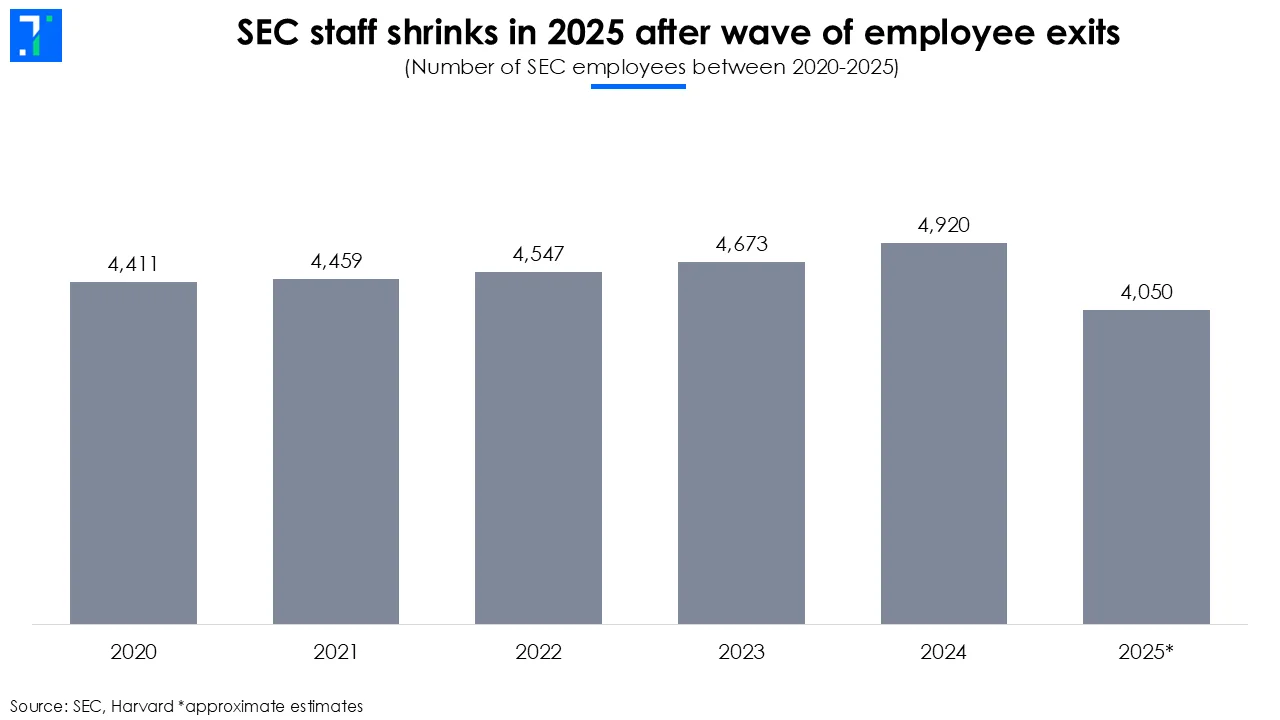
    The US Securities and Exchange Commission (SEC) has been losing staff faster than the rest of the federal government. Exits have come in waves. Around 600 employees, about 12% of its workforce, left through buyouts by last May. By September, another 270 had departed outside these programs.

    Together, this pushed the agency’s headcount down 18% in the 2025 fiscal year, pointing to a sustained thinning of staff.
    Margaret “Meg” Ryan, the US SEC Director of the Division of Enforcement, resigned mid-March after just six months in the role. This high-profile exit has raised eyebrows across the financial industry. Ryan had reportedly clashed with agency leaders over the direction of the SEC’s enforcement program, including the 'unusual' handling of cases with ties to President Donald Trump and his family.

    Weeks before her resignation, the SEC also settled rather than prosecuted a fraud case with Chinese crypto entrepreneur Justin Sun for $10 million. The case, filed in 2023, had accused him of unregistered sale of crypto assets and market manipulation that inflated TRX and BTT token prices by $31 million.

    Sun is coincidentally, a major investor in a cryptocurrency project tied to President Trump. He holds $18.6 million in $TRUMP tokens, in addition to the $75 million he previously invested in World Liberty Financial, a crypto platform that directs 75% of revenues to Trump-owned entities.

    A key mechanism for uncovering insider activity is the SEC’s whistleblower program, which was designed to encourage individuals to report market misconduct by offering financial incentives. But recent data suggests a big decline. In FY25, the SEC awarded just over $60 million to 48 whistleblowers, a steep drop from $255 million in the previous year.
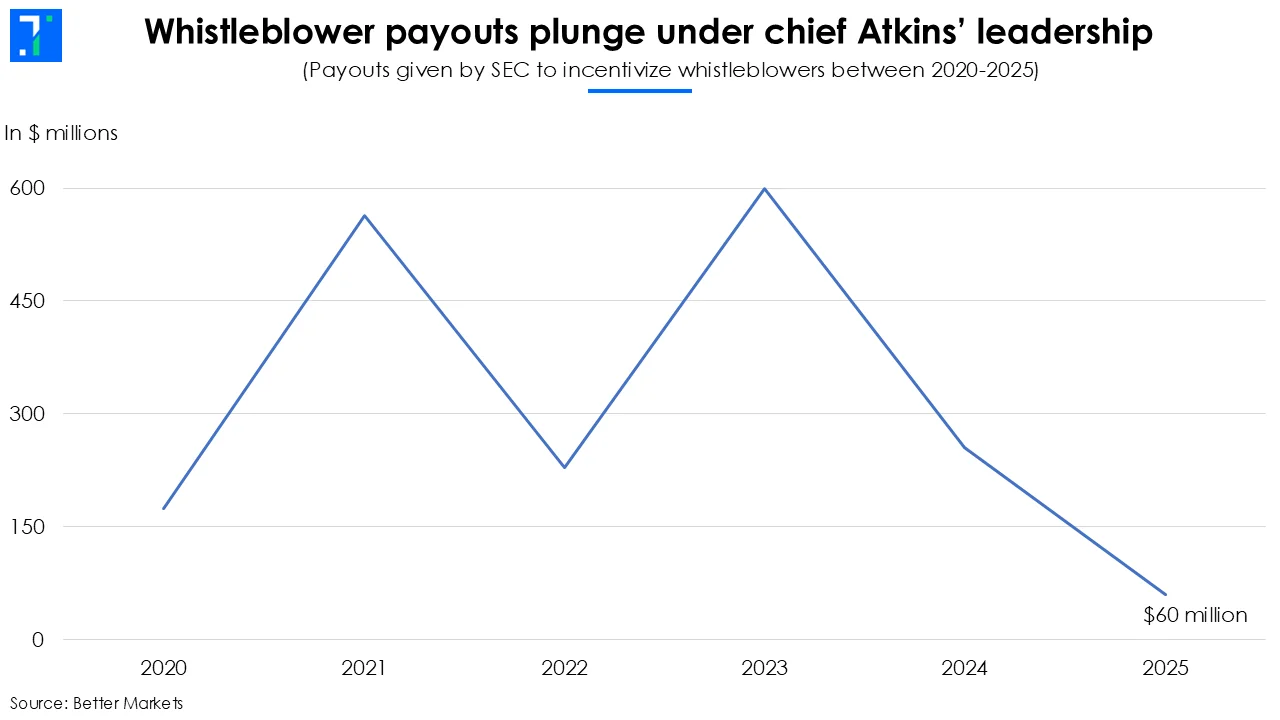
    This drop reflects a shift in how claims are handled. The SEC rejected far more whistleblower applications, with hundreds turned down in final decisions. As a result, only 13% of cases led to payouts, down sharply from nearly 50% in 2022.

    Stephen Kohn, a partner at a whistleblower advocacy firm, notes that the SEC appears to be applying stricter filters. “They are looking for hyper-technical reasons to disqualify someone,” he said, adding that this runs counter to the intent of the law, which was designed to encourage individuals to come forward and report misconduct despite the risks involved.

    Fewer crackdowns, monetary settlements nosedive to a five-year low

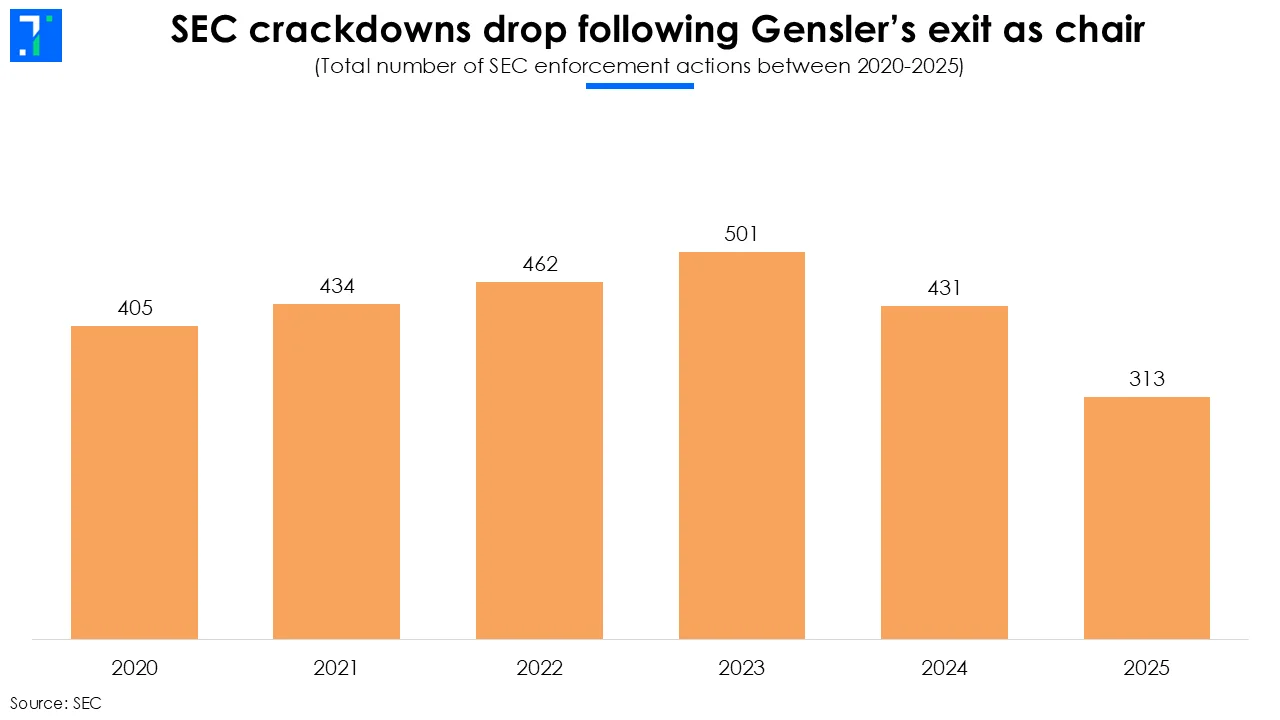
    Even though the SEC has yet to release its official FY25 enforcement data, an analysis by Harvard Law School indicates that the agency brought 313 new enforcement actions, the lowest level in a decade. This marks a 38% drop from its recent peak in FY2023, where it recorded 501 new cases.

    The slowdown is even more pronounced in actions involving public companies. The SEC recorded 56 such cases in FY25, down about 30% from the previous year. Of these, 52 were initiated under former Chair Gary Gensler, leaving just four actions under the new administration, marking the lowest annual count since 2013.
    The shift also shows up in outcomes. Total monetary settlements fell 45% YoY to $808 million, the lowest since 2012 and well below the $1.9 billion average between 2016 and 2024.

    Taken together, the data points to a clear slowdown in enforcement activity, both in the number of cases brought as well as the scale of penalties imposed.

    From “Top Cop” to Facilitator

    In his brief tenure, as chair Paul Atkins has called his taking over “a new day at the SEC”. The agency is moving closer to the Donald Trump administration’s push to position the US as a hub for digital assets.

    Atkins has made it clear that he wants rules set upfront. The SEC’s Spring agenda included plans to simplify disclosure requirements and focus on what "truly matters" to investors. The aim, he said, is to rely less on after-the-fact action and more on clear guidance.

    This shift is most visible in crypto. Within weeks of taking office, the SEC dropped its case against Coinbase, which had argued that some tokens were unregistered securities. Around the same time, it closed investigations into firms such as Gemini, Uniswap Labs, and OpenSea. Similar decisions followed through 2025 in cases involving Crypto.com, Binance, Robinhood, and Ondo Finance.

    The change in approach is clear. The SEC is pulling back from earlier crackdowns while it reworks how crypto is regulated.

    Even so, some major cases remain. The SEC is in settlement talks with Elon Musk over claims that he illegally delayed disclosing his initial stake in Twitter in 2022, which allowed him to buy more shares before the stake was disclosed.

    A federal judge has allowed the case to proceed, with the agency seeking $150 million.

    These cases show that while the broader stance is shifting, enforcement has not disappeared. But the trend is clear - fewer crackdowns, less manpower for oversight, and fewer whistleblower rewards.

    Copy LinkShare onShare on Share on Share on
     
    logo
    The Baseline US
    20 Feb 2026
    Someone has to be wrong about AI

    Someone has to be wrong about AI

    Hi {firstname},

    The recent panic unleashed in the stock market around AI, reflects two fears that are increasingly at odds.

    One concern is that AI is set to disrupt entire segments of the economy so dramatically that investors are dumping the stocks of any company seen at the slightest risk of being displaced by the technology. Mentions of AI disruption in earnings calls surged to a record in Q4.

    The other is a deep skepticism that the hundreds of billions of dollars that tech giants like Amazon, Meta, Microsoft and Alphabet are pouring into AI every year will deliver payoffs anytime soon.

    Take Amazon. The company recently outlined plans for $200 billion in capital expenditure for 2026, largely aimed at expanding its data center footprint to support AI workloads. Yet its cloud division, Amazon Web Services, has been growing at a slower pace than its peers.

    The scale of private sector spending is even more striking. OpenAI’s projected cash burn is unlike anything the notoriously high spending tech sector has ever seen before. The company expects to burn $218 billion between 2026 and 2029, about $111 billion more than the company’s internal projections from just two quarters ago. Even by Silicon Valley standards, the numbers are huge.

    These dueling fears have been brewing for months, but became the focus of the stock market over the past few weeks. When markets try to price in two conflicting futures at once, volatility is the result.

    In this week's newsletter, we assess where the market is headed.

    AI models have improved a lot since their genesis

    To see how much AI has improved, researchers use a benchmark called ‘massive multitask language understanding’, or MMLU. This is a lot like a comprehensive exam covering 57 subjects, including math, history, law and computer science.

    The test measures whether a model actually understands tough questions across disciplines. It's the kind of exam not many humans, even the ones with tiger moms, can solve. Human domain experts on average score slightly below 90% in this test.  

    When GPT-3 was released in 2020, it scored about 44%. The model got many answers wrong. Recent models now score above 90%, which points to better accuracy and reasoning.

    Models have also become more competitive with each other. Research by Moody’s notes, “AI models are converging in performance, making small differences in benchmark scores less important.” The study also finds that GenAI tools help professionals work faster while giving them access to more information and insights.

    Most industry forecasts suggest that AI development is still in its early innings.

    Consulting firms and technology strategists expect AI systems to become more autonomous, more specialized and increasingly embedded in enterprise workflows over the next three to five years. The focus is shifting from general chat interfaces to task-specific agents that can manage workflows end-to-end.

    Hyperscalers ready to pour in trillions to advance AI

    The scale of capital being deployed by the world’s largest technology companies is immense. The collective capital expenditure from the major AI hyperscalers is set to exceed $650 billion this year, 60% higher than in 2025, as they build out data center and AI infrastructure.

    Players like Microsoft, Amazon, Alphabet, Meta Platforms and Oracle are expected to spend in aggregate about 90% of their operating cash flow on capex in 2026, according to Bank of America. That’s up from 65% in 2025.

    The private side of the AI world is also fueling this build-out. OpenAI’s plans to spend up to $1.4 trillion on computing power over the next eight years, even as it continues to rack up heavy losses.

    The cost of staying competitive in this space is clearly enormous, a Goliath versus Goliath matchup. Even companies generating tens of billions in revenue are burning capital at historic levels to maintain leadership.

    OpenAI reached roughly $20 billion in annualized revenue by the end of 2025, yet it is projected to lose around $14 billion in 2026 as it continues investing heavily in new AI models. Anthropic, which owns Claude, shows the same gap. The company is valued at about 27 times revenue, while spending keeps rising. In 2026, it plans to spend about $12 billion to train models and another $7 billion to run them. The company now expects to turn cash-flow positive in 2028, one year later than its earlier projection. The valuation depends more on future outcomes than on current results.

    AI scare drives capital into bot-resilient sectors

    On February 3, 2026, the S&P 500 Software Index fell 13% in a single session, erasing nearly a trillion dollars in market value. 

    If AI agents can perform tasks that once required teams of employees and multiple software subscriptions, demand for traditional software licenses could weaken. “We think application software faces an existential threat from AI,” said Nick Evans, a Polar Capital fund manager. His $12 billion global technology fund beat 99% of peers over one year and 97% over the past five.

    After the sharp selloff, a growing group of investors is rotating toward sectors that appear less vulnerable to AI disruption. Instead of betting on who wins the AI race, they are asking: Which industries will continue to generate steady returns regardless of how the AI narrative plays out?

    Trendlyne’s sector dashboard shows growing interest in Industrials, Energy, select Consumer Staples, and parts of Healthcare. These industries benefit from physical assets, regulatory complexity or human-centric demand that is harder to replace with code.

    Importantly, these sectors are not completely AI-untouched, but are integrating it more selectively to raise efficiencies. Industrial firms are using AI for predictive maintenance, while Healthcare providers are applying AI for diagnostic support and administration. Energy companies are optimizing logistics and drilling efficiency through data-driven models.

    Not everyone believes software’s pain will last. Michael Toomey, managing director of equities trading at Jefferies, noted that 73% of software stocks are oversold and that “we're due for a vicious rally in software.”

    In this market, there could be value for investors in focusing on the fundamentals: companies with steady cash flows, improving macro conditions, and disciplined AI integration likely offer a more predictable path in returns, than trying to bet on the next AI model breakthrough.

    As always,
    The Trendlyne team

    Copy LinkShare onShare on Share on Share on
     
    logo
    The Baseline US
    07 Feb 2026
    While everyone was watching AI, this sector entered a supercycle

    While everyone was watching AI, this sector entered a supercycle

    Wall Street spent the last year obsessing over AI earnings calls and GPU shipments. But while the market got caught up with shiny new tech, something far less fashionable was moving, with big implications.

    For most of the last decade, mining was the market’s underperformer, capital-intensive, politically risky, and prone to value destruction. It's now got its makeover. Metals and mining have emerged as one of the best-performing segments this quarter, and the move is not driven by a short-term rebound in prices. Tech companies that used to be asset-light are leaning heavily into building physical infrastructure, as data center capex soars. This is driving demand for key metals higher.

    Jeff Currie, Chief Strategy Officer at Carlyle, said, “Anything that has an atomic number to it is going up right now. What’s going on in the metals space is hoarding, driven by the 'Three Ds': Debasement, De-dollarization, and Defense.”

    “Mining stocks have moved from a boring defensive to an essential portfolio piece. It is one of the few sectors positioned to capture both shifting monetary policy dynamics and an increasingly volatile geopolitical landscape,” said Dilin Wu, a research strategist at Pepperstone Group in Melbourne.

    Geopolitical shift: China forces a rethink

    Geopolitics is causing volatility across markets, with rising export controls, tariffs, and strategic stockpiling.

    The inflection point came in late 2025, when China tightened export controls on rare-earth magnets and critical processing equipment. With China controlling roughly 90% of global rare-earth refining capacity, the move exposed a major vulnerability for Western manufacturers of electric vehicles, wind turbines, consumer electronics, and defense systems.

    The US government has responded by signaling that it won't act just as a regulator, but as a strategic investor to secure access to critical materials. Just last month, the Trump administration took a 12% stake in USA Rare Earth for $1.6 billion, backing projects such as the Sierra Blanca mine in Texas and a magnet manufacturing facility in Oklahoma.

    The Trump administration has already built stakes across the critical minerals supply chain, including rare-earth producerMP Materials, lithium developer Lithium Americas, and a Canadian base-metal miner, Trilogy Metals.

    Processing capacity has become key as well. For years, ore extracted outside China still flowed back there for refinement, creating a hidden choke point. Companies such as Energy Fuels and Ucore Rare Metals are drawing attention by addressing this downstream gap by building processing and separation capacity in North America.

    Gold makes a case to be in everyone’s portfolio

    For much of the past two decades, US Treasuries anchored the global financial system, making up roughly 60–70% of global central-bank reserves in the early 2000s, while gold accounted for just 10–15%. 

    Trust in currencies can be risky, as countries change behaviour and priorities. The balance between the dollar and gold began to see-saw after the 2008 financial crisis, but the real break came in 2022, when Western governments froze Russian central-bank assets following the Ukraine invasion. The message to reserve managers was unambiguous: foreign-currency assets can become politically inaccessible. Since then, the reserve-management playbook has changed. High sovereign debt, repeated liquidity injections, and the expanded use of financial sanctions have made reserves more political.

    Central banks have been buying accordingly. In 2025 alone, central banks purchased 863 tonnes, well above long-term averages.

    Gold briefly sold off after Donald Trump nominated Kevin Warsh as Federal Reserve Chair, a move markets interpreted as signaling a more hawkish policy stance. The pullback prompted some tactical selling. George Efstathopoulos, a money manager at Fidelity International, said he reduced gold exposure ahead of what became the metal’s sharpest decline in decades.

    He is now preparing to re-enter. “If we see another 5% to 7% correction, I’m buying,” Efstathopoulos said in an interview, adding that “a lot of the froth has been taken out, and the structural medium-term themes remain firmly in place.” Even after the pullback, gold remains up nearly 70% over the past year.

    Precious metals mining companies such as Newmont, Barrick Gold, and Kinross Gold are benefiting from higher realized prices without proportional cost inflation. Industry executives argue the sector has finally broken the old “cost curse,” allowing price gains to flow more directly to margins.

    Base metals join the rally

    The move extends well beyond gold and silver. Prices for copper, aluminum, nickel, and zinc rise alongside gold, reflecting what many traders describe as an “everything rally” in metals.

    Unlike past cycles, this move is not driven by speculation alone, but is anchored in physical demand.

    These metals sit at the core of electrification. AI data centers, power grids, electric vehicles, and renewable energy systems all require large quantities of copper and aluminum, while silver plays a critical role in advanced electronics. “Silver is the world’s best electrical conductor. High-speed connections in computers, smartphones, AI systems and data centers depend on it,” said Pan American Silver CEO Michael Steinmann.

    Supply is struggling to respond. High energy costs and environmental regulations cap smelter output in China and Europe. Aging mines in Chile and Peru face declining ore grades, forcing miners to process far more rock to produce the same output as two decades ago.

    New supply takes time. A copper mine typically takes 15–20 years to reach production. Even at current prices, many greenfield projects fail to clear return thresholds. Most producers focus instead on incremental expansions at existing sites, and those additions remain limited.

    Demand, meanwhile, keeps accelerating. Global electricity consumption is projected to rise by around 50% over the next decade, driving copper and silver use across power generation, transmission, and storage. The International Copper Study Group (ICSG) forecasts the refined copper market swinging to a deficit of 150,000 metric tons in 2026 from the previously expected surplus of 209,000 tons.

    To satisfy this demand, Robert Friedland, Founder of a Canadian mining company, says, ”We have to mine the same amount of copper in the next 18 years as we mined in the last 10,000 years combined to maintain 3% GDP growth.”

    Producers with scale stand to benefit most. Freeport-McMoRan and Southern Copper offer direct leverage to higher copper prices through long-life assets. In aluminum, Alcoa benefits from higher domestic pricing as tariffs raise import costs.

    Taken together, these forces point to a fundamental revaluation of the mining sector. If this is a supercycle, it is not because commodities have become fashionable, but a shift forced by the world relearning an old truth: the digital economy still runs on physical resources, and those resources are finite.

    Copy LinkShare onShare on Share on Share on
     
    logo
    The Baseline US
    22 Jan 2026
    Messy global politics is happy news for one industry: defense

    Messy global politics is happy news for one industry: defense

    Let’s be real. The current geopolitical chaos signals sunny days for the defense industry.

    Companies got ready to pop the champagne when US President Donald Trump said the United States should set its military budget for 2027 at $1.5 trillion, 66% higher than 2026 levels. This increase, he argued, was necessary to build what he called a “Dream Military” (led by the Secretary of War and former Fox News host Pete Hegseth).

    The budget hike will help the US fund the “Golden Dome” missile system alongside other plans. The Trump administration initially projected $175 billion in cost for the Golden Dome over three years to get it operational. The Congressional Budget Office pegged costs at upto $542 billion over 20 years to add elements like space-based interceptors.

    Then there's Greenland. Treasury Secretary Scott Bessent didn't mince words at Davos, calling Greenland “strategically important for the Golden Dome project to protect the US.” He insisted that “US control of Greenland stops kinetic war before it starts.”

    Defense Tweet

    As these dramas unfold, it is clear that the US defense industry is going to thrive, thanks to the influx of money and Trump's sabre rattling driving demand. The only question right now is whether the US defense industrial complex can deliver.

    I say this because today’s US defense industry isn’t like the one that helped win the Cold War.

    One key change is consolidation. There was a massive loss of competition in the sector during the “peace dividend” years of the 1990s. The late 1990s saw more than two dozen major firms merge into three behemoths, Boeing Co., Lockheed Martin Corp. and RTX Corp. That came in the wake of a 1993 Pentagon meeting dubbed the “Last Supper,” where CEOs of big defense companies were informed the government expected some of them to go out of business as defense spending wound down. Countless small firms disappeared.

    Prime defense contractors emerge as the biggest winners

    Today’s US defense sector, home to over 60,000 firms feeding the Pentagon's needs, is dominated by five heavyweights: Boeing, Lockheed Martin, RTX, Northrop Grumman and General Dynamics, which together snag nearly a third of all contracts.

    Last year, their stocks all climbed, but RTX stole the show with over 70% gains, outpacing its peers amid booming revenues. “Global demand is rising, especially in Europe,” one analyst noted, as RTX's Q3FY26 results showed 12% sales growth to $22.5 billion, powered by Patriot missiles and F135 engines.

    Lockheed grew sales 9% on record F-35 deliveries (191 in 2025), while General Dynamics posted 11% revenue growth driven by Gulfstream jet sales and submarine programs. Northrop Grumman posted 8% revenue growth, while Boeing’s defense unit grew 25%. Trump has been good for defense spending, both in the US and abroad.

    Defense Prices

    Sky-high order backlogs (signed contracts yet to be executed) are also providing years-long sales visibility, so a lot of future revenue is baked in. Lockheed Martin tops the list at a record $179 billion in order backlogs, fueled by F-35s and missile purchases. General Dynamics isn't far behind with over $110 billion - a nice, fat multi-year cushion.

    RTX sits at $103 billion, Northrop at $91 billion, and Boeing's defense unit at $76 billion. In a world of uncertain budgets, this mountain of backlog orders signifies continued good times ahead for defense CEOs.

    Order Backlogs

    No one's standing still—these firms are pouring cash into factories to keep up. Lockheed is "scaling F-35 lines aggressively," RTX is expanding missile and engine output, and Northrop is ramping up B-21 and space systems.

    General Dynamics is boosting submarine and tank production, while Boeing eyes BDS growth. "Capacity constraints are the new bottleneck," warned an industry briefing.

    Geopolitics and the Arctic: demand that doesn’t switch off

    Global defense spending has shifted from a reactive wartime response to a permanent priority. The wars in Ukraine and the Middle East, along with sustained US–China rivalry, have ended the old cycle of spending spikes followed by pullbacks. Governments are now investing continuously to deter future conflict.

    Defense Table

    After years of underinvestment, NATO is restocking fast. Members plan to lift defense spending to 5% of GDP by 2035—3.5% for core military needs and 1.5% for security infrastructure. US systems are preferred because they integrate easily with existing NATO platforms.

    Kathy Warden, CEO of Northrop Grumman, pointed to the company’s 1.17 book-to-bill ratio, which indicate that new order intake is outpacing deliveries. She said, “The company’s portfolio is aligned with NATO’s new spending priorities, including the 1.5% allocation for security infrastructure.”

    That relationship, however, is not risk-free. Trump’s aggressive push to acquire Greenland highlights how political ambitions can quickly spill into concerns in Europe around buying weapons from US companies.

    Stratfor warns that “a coercive US military move on Greenland would accelerate European rearmament and strategic decoupling,” pushing European governments to favor domestic suppliers over US defense firms.

    President Trump pushes for major reforms

    The US defense budget for FY2026, signed into law by President Trump on December 18, 2025, totals approximately $901 billion through the National Defense Authorization Act (NDAA). This is expected to surge by another half a trillion dollars if Trump’s $1.5 trillion defense budget is approved.

    Defense Budget

    However, near-term sentiment deteriorated on January 7, 2026, when defense stocks plummeted 5-8% in a single session. This was triggered by President Trump's surprise executive order banning stock buybacks and dividends for contractors failing delivery timelines.

    RTX shares cratered 8.2% after Trump's Truth Social post singled them out:"Raytheon must refrain from any further stock buybacks until they rectify their practices", sparking panic over the "Prioritizing the Warfighter" EO's immediate enforcement on delayed Patriot missile and F135 engine programs.

    The broader sector selloff deepened as analysts warned of capped executive pay and forced factory reinvestments, with Lockheed (-6.1%) and Northrop (-5.9%) hit hardest amid Golden Dome prototype delays.

    On the positive side for private players, the Pentagon is trying something new: a partnership with L3Harris Technologies, where they will invest in the company’s missile unit with a $1 billion convertible preferred security. Creating a government stake could catalyze wider investment from private-sector actors, says Becca Wasser, defense lead for Bloomberg Economics.

    Analysts at Morgan Stanley maintain an "Overweight" rating on key players like General Dynamics and Northrop Grumman, citing the sheer scale of geopolitical events.

    As Tony Bancroft, a portfolio manager at Gabelli Funds, recently put it, the sector's resilience is "underpinned by long-term contracts and newly predictable revenue streams." We are entering a defense "supercycle", as political leaders globally worry about rising threats on land and sea. 

    Picture of the week

    Asher Perlman on a tipping culture gone haywire. 

    As always,
    The Trendlyne team

    Copy LinkShare onShare on Share on Share on
     
    logo
    The Baseline US
    08 Jan 2026
    From screws to superstars: memory chip makers are in the spotlight, thanks to AI

    From screws to superstars: memory chip makers are in the spotlight, thanks to AI

    For decades, memory chips were the unloved screws, the overlooked backbone of hardware technology: cheap, interchangeable, and easily forgotten. That era is coming to an end.

    “Memory bandwidth has become the key factor deciding whether a complex AI model succeeds or stalls,” say Citi analysts. And as AI ramps up in both hype and usefulness, memory chips are getting their moment in the sun. 

    Memory chips provide the working environment that allows processors from Nvidia to Intel to perform calculations. They are the digital heart of everything from hyperscale data centers and cars, to smartphones and household appliances. Now, artificial intelligence has turned them into a major choke point.

    The warning signs are everywhere. Samsung Co-CEO TM Roh said, “No company is immune to memory shortages, including mobile phones, TVs, and other consumer electronics.”

    Memory Chip Tweet

    Dell Technologies and HP have flagged potential memory shortages in the coming year, as AI infrastructure spending accelerates. Counterpoint Research expects memory module prices to jump as much as 50% by mid-2026. Lenovo has begun stockpiling memory chips to get ahead of rising costs.

    The supply crunch comes down to a specific culprit, High-Bandwidth Memory (HBM). These specialized chips sit right next to AI processors and determine how fast a system can learn and scale.

    Supply right now is incredibly tight. Only three companies on earth manufacture HBM chips at scale. All of them are operating near full capacity, leaving no room for error.

    HBM supply stays tight, with only three players

    There used to be more companies in the HBM space. But famously, even Intel, which invented the modern memory industry, and companies in Taiwan, the epicenter of leading chip production, gave up due to the capital-intensive nature of the business and razor-thin margins in the past.

    Memory chips market share

    Micron Technology is now the only US-based manufacturer with meaningful exposure to HBM, supplying advanced HBM3 and HBM3E chips used in AI accelerators. Thanks to soaring demand, Micron has transformed from a company struggling with excess inventory, to a critical AI linchpin. 

    The firm has seen gross margins improve by over 15 percentage points over the past year. Profits recovered meaningfully in 2025, with multi-year customer contracts. This turnaround has propelled Micron’s stock to more than triple over the past year.

    Memory chips price action


    Globally, the center of gravity for memory chips sits in South Korea. SK Hynix emerged as the market leader after investing early, and aligning closely with Nvidia’s accelerator roadmap. That first-mover advantage translated into a 274% share price surge in 2025, as AI demand absorbed nearly all its available supply. Samsung Electronics, despite execution challenges and slower customer approval, also delivered around 125% gains over the same period.

    AI is crowding out your electronic devices

    Factories are now prioritizing these high-speed, complex HBM chips for AI. Because these are harder to make, they are cannibalizing the production capacity for lower-end memory used in smartphones and laptops. Micron CEO Sanjay Mehrotra says memory markets “could remain tight past 2026,” as AI demand keeps production diverted to high-end chips.

    Japanese electronics retailers have already begun limiting the number of hard-disk drives customers can buy. Chinese smartphone makers are warning consumers of imminent price hikes. Meanwhile, tech giants including Microsoft, Google, and ByteDance are racing to lock in long-term contracts for memory chips.

    DRAM, a type of high-speed memory chip that temporarily stores data for computers and AI processors, is in short supply. Inventories have dropped about 80% from last year, leaving only three weeks of stock, as AI data centre demand uses most of the capacity.

    Memory chips shortage

    A prolonged chip shortage could slow AI-driven productivity gains and delay hundreds of billions in planned digital infrastructure. “The memory shortage has now become a macroeconomic risk,” said Sanchit Vir Gogia, CEO of Greyhound Research. The global AI build-out, he warns, “is colliding with a supply chain that cannot meet its physical requirements.”

    A $400 billion supercycle

    The global memory market is in a high growth phase, and industry forecasts project annual growth of over 12% through 2030, driven by AI workloads, cloud data centers, and high-performance computing. The global memory chip market could triple from $125 billion in 2024 to nearly $400 billion by 2034.

    Memory chips market size

    New factories take years to build, even as memory chip manufacturers are speeding up their timelines. SK Hynix is building a $3.9 billion facility in West Lafayette, Indiana. By 2028, SK Hynix expects to ship finished HBM stacks directly to US AI accelerator assembly lines. But that's two years away.

    Backed by US CHIPS Act incentives, Micron has lifted FY26 capital spending to $20 billion, a 45% YoY increase, with most of that directed toward HBM. But Micron’s new chip factories in Idaho and New York are still years away.

    Similarly, Samsung Electronics plans to raise total HBM capacity by around 50% by the end of 2026, driven by expansion at its Pyeongtaek campus, the world’s largest semiconductor complex.

    These initiatives will not eliminate shortages overnight. Analysts from Morningstar and JP Morgan estimate that the ongoing “supercycle” might persist well into 2027. AI has permanently raised the memory content per server. This is a fundamental reset, and one that will benefit memory chip makers in the long term.

    Copy LinkShare onShare on Share on Share on
     
    more
    loading
    Trendlyne Logo Trendlyne
    Stay ahead of the market
    Quick Links
    • Contact us
    • Blogs
    • FAQs
    • All Features
    Markets Today
    • S&P today
    • Dow today
    • Latest Quarterly results
    Dashboard
    • Industry & Sector analysis
    • ETFs
    • Bullish & Bearish spread
    • Global Indices
    • Events Calendar
    Tools
    • Compare stocks
    • Widgets
    • Data Downloader
    • Excel Connect
    Company
    • Privacy
    • Terms of Use
    • Disclaimer
    Trendlyne Products
    • Starfolio
    • SmartOptions
    • Trendlyne India
    Get Mobile App
    • Android
    • iOS

    Copyright © 2026 Giskard Datatech Pvt Ltd (RA SEBI Reg No: INH000022507)