• Trendlyne logo
  • Markets
  • Superstars
  • Analyst Estimates
  • Alerts
  • Screeners
  • Subscribe
  • Calendar
  • ETFs
  • Portfolio
  • Watchlist
  • Insider Trades
  • Results
  • Data Downloader
  • Events Calendar
  • Explore
  • FAQs
  • All Features
  • Widgets
More
    Search stocks
    IND USA
    USA
    USA
    IND
    USA
    • Stocks
    • News
    • Fundamentals
    • Reports
    • Corporate Actions
    • Alerts
    • Shareholding

    The Baseline US

    0
    Stocks Tracked
    0
    Sectors & Interests
    Follow
    logo
    The Baseline US
    20 Feb 2026
    Someone has to be wrong about AI

    Someone has to be wrong about AI

    Hi {firstname},

    The recent panic unleashed in the stock market around AI, reflects two fears that are increasingly at odds.

    One concern is that AI is set to disrupt entire segments of the economy so dramatically that investors are dumping the stocks of any company seen at the slightest risk of being displaced by the technology. Mentions of AI disruption in earnings calls surged to a record in Q4.

    The other is a deep skepticism that the hundreds of billions of dollars that tech giants like Amazon, Meta, Microsoft and Alphabet are pouring into AI every year will deliver payoffs anytime soon.

    Take Amazon. The company recently outlined plans for $200 billion in capital expenditure for 2026, largely aimed at expanding its data center footprint to support AI workloads. Yet its cloud division, Amazon Web Services, has been growing at a slower pace than its peers.

    The scale of private sector spending is even more striking. OpenAI’s projected cash burn is unlike anything the notoriously high spending tech sector has ever seen before. The company expects to burn $218 billion between 2026 and 2029, about $111 billion more than the company’s internal projections from just two quarters ago. Even by Silicon Valley standards, the numbers are huge.

    These dueling fears have been brewing for months, but became the focus of the stock market over the past few weeks. When markets try to price in two conflicting futures at once, volatility is the result.

    In this week's newsletter, we assess where the market is headed.

    AI models have improved a lot since their genesis

    To see how much AI has improved, researchers use a benchmark called ‘massive multitask language understanding’, or MMLU. This is a lot like a comprehensive exam covering 57 subjects, including math, history, law and computer science.

    The test measures whether a model actually understands tough questions across disciplines. It's the kind of exam not many humans, even the ones with tiger moms, can solve. Human domain experts on average score slightly below 90% in this test.  

    When GPT-3 was released in 2020, it scored about 44%. The model got many answers wrong. Recent models now score above 90%, which points to better accuracy and reasoning.

    Models have also become more competitive with each other. Research by Moody’s notes, “AI models are converging in performance, making small differences in benchmark scores less important.” The study also finds that GenAI tools help professionals work faster while giving them access to more information and insights.

    Most industry forecasts suggest that AI development is still in its early innings.

    Consulting firms and technology strategists expect AI systems to become more autonomous, more specialized and increasingly embedded in enterprise workflows over the next three to five years. The focus is shifting from general chat interfaces to task-specific agents that can manage workflows end-to-end.

    Hyperscalers ready to pour in trillions to advance AI

    The scale of capital being deployed by the world’s largest technology companies is immense. The collective capital expenditure from the major AI hyperscalers is set to exceed $650 billion this year, 60% higher than in 2025, as they build out data center and AI infrastructure.

    Players like Microsoft, Amazon, Alphabet, Meta Platforms and Oracle are expected to spend in aggregate about 90% of their operating cash flow on capex in 2026, according to Bank of America. That’s up from 65% in 2025.

    The private side of the AI world is also fueling this build-out. OpenAI’s plans to spend up to $1.4 trillion on computing power over the next eight years, even as it continues to rack up heavy losses.

    The cost of staying competitive in this space is clearly enormous, a Goliath versus Goliath matchup. Even companies generating tens of billions in revenue are burning capital at historic levels to maintain leadership.

    OpenAI reached roughly $20 billion in annualized revenue by the end of 2025, yet it is projected to lose around $14 billion in 2026 as it continues investing heavily in new AI models. Anthropic, which owns Claude, shows the same gap. The company is valued at about 27 times revenue, while spending keeps rising. In 2026, it plans to spend about $12 billion to train models and another $7 billion to run them. The company now expects to turn cash-flow positive in 2028, one year later than its earlier projection. The valuation depends more on future outcomes than on current results.

    AI scare drives capital into bot-resilient sectors

    On February 3, 2026, the S&P 500 Software Index fell 13% in a single session, erasing nearly a trillion dollars in market value. 

    If AI agents can perform tasks that once required teams of employees and multiple software subscriptions, demand for traditional software licenses could weaken. “We think application software faces an existential threat from AI,” said Nick Evans, a Polar Capital fund manager. His $12 billion global technology fund beat 99% of peers over one year and 97% over the past five.

    After the sharp selloff, a growing group of investors is rotating toward sectors that appear less vulnerable to AI disruption. Instead of betting on who wins the AI race, they are asking: Which industries will continue to generate steady returns regardless of how the AI narrative plays out?

    Trendlyne’s sector dashboard shows growing interest in Industrials, Energy, select Consumer Staples, and parts of Healthcare. These industries benefit from physical assets, regulatory complexity or human-centric demand that is harder to replace with code.

    Importantly, these sectors are not completely AI-untouched, but are integrating it more selectively to raise efficiencies. Industrial firms are using AI for predictive maintenance, while Healthcare providers are applying AI for diagnostic support and administration. Energy companies are optimizing logistics and drilling efficiency through data-driven models.

    Not everyone believes software’s pain will last. Michael Toomey, managing director of equities trading at Jefferies, noted that 73% of software stocks are oversold and that “we're due for a vicious rally in software.”

    In this market, there could be value for investors in focusing on the fundamentals: companies with steady cash flows, improving macro conditions, and disciplined AI integration likely offer a more predictable path in returns, than trying to bet on the next AI model breakthrough.

    As always,
    The Trendlyne team

    Copy LinkShare onShare on Share on Share on
     
    logo
    The Baseline US
    07 Feb 2026
    While everyone was watching AI, this sector entered a supercycle

    While everyone was watching AI, this sector entered a supercycle

    Wall Street spent the last year obsessing over AI earnings calls and GPU shipments. But while the market got caught up with shiny new tech, something far less fashionable was moving, with big implications.

    For most of the last decade, mining was the market’s underperformer, capital-intensive, politically risky, and prone to value destruction. It's now got its makeover. Metals and mining have emerged as one of the best-performing segments this quarter, and the move is not driven by a short-term rebound in prices. Tech companies that used to be asset-light are leaning heavily into building physical infrastructure, as data center capex soars. This is driving demand for key metals higher.

    Jeff Currie, Chief Strategy Officer at Carlyle, said, “Anything that has an atomic number to it is going up right now. What’s going on in the metals space is hoarding, driven by the 'Three Ds': Debasement, De-dollarization, and Defense.”
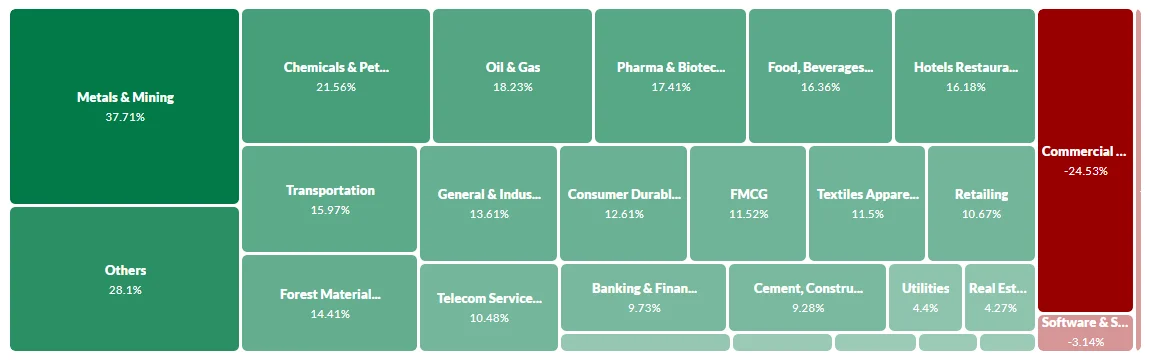
    “Mining stocks have moved from a boring defensive to an essential portfolio piece. It is one of the few sectors positioned to capture both shifting monetary policy dynamics and an increasingly volatile geopolitical landscape,” said Dilin Wu, a research strategist at Pepperstone Group in Melbourne.

    Geopolitical shift: China forces a rethink

    Geopolitics is causing volatility across markets, with rising export controls, tariffs, and strategic stockpiling.

    The inflection point came in late 2025, when China tightened export controls on rare-earth magnets and critical processing equipment. With China controlling roughly 90% of global rare-earth refining capacity, the move exposed a major vulnerability for Western manufacturers of electric vehicles, wind turbines, consumer electronics, and defense systems.
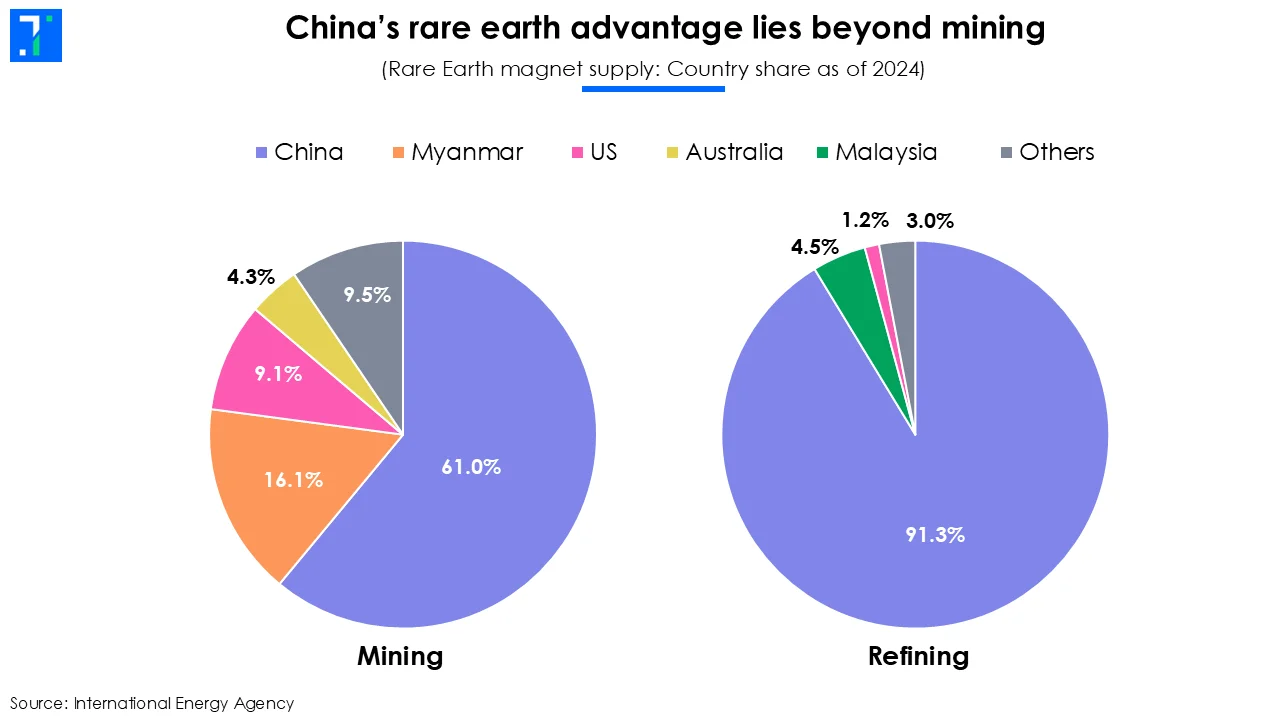
    The US government has responded by signaling that it won't act just as a regulator, but as a strategic investor to secure access to critical materials. Just last month, the Trump administration took a 12% stake in USA Rare Earth for $1.6 billion, backing projects such as the Sierra Blanca mine in Texas and a magnet manufacturing facility in Oklahoma.

    The Trump administration has already built stakes across the critical minerals supply chain, including rare-earth producerMP Materials, lithium developer Lithium Americas, and a Canadian base-metal miner, Trilogy Metals.

    Processing capacity has become key as well. For years, ore extracted outside China still flowed back there for refinement, creating a hidden choke point. Companies such as Energy Fuels and Ucore Rare Metals are drawing attention by addressing this downstream gap by building processing and separation capacity in North America.

    Gold makes a case to be in everyone’s portfolio

    For much of the past two decades, US Treasuries anchored the global financial system, making up roughly 60–70% of global central-bank reserves in the early 2000s, while gold accounted for just 10–15%. 

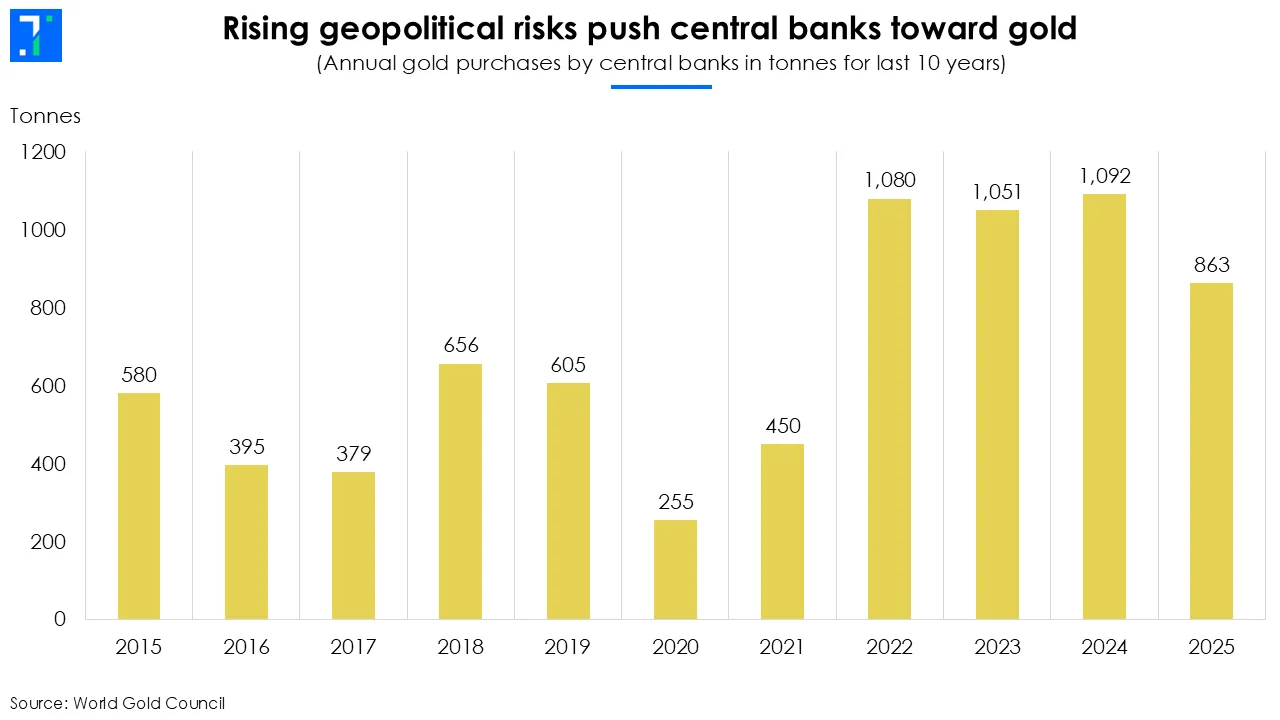
    Trust in currencies can be risky, as countries change behaviour and priorities. The balance between the dollar and gold began to see-saw after the 2008 financial crisis, but the real break came in 2022, when Western governments froze Russian central-bank assets following the Ukraine invasion. The message to reserve managers was unambiguous: foreign-currency assets can become politically inaccessible. Since then, the reserve-management playbook has changed. High sovereign debt, repeated liquidity injections, and the expanded use of financial sanctions have made reserves more political.

    Central banks have been buying accordingly. In 2025 alone, central banks purchased 863 tonnes, well above long-term averages.
    Gold briefly sold off after Donald Trump nominated Kevin Warsh as Federal Reserve Chair, a move markets interpreted as signaling a more hawkish policy stance. The pullback prompted some tactical selling. George Efstathopoulos, a money manager at Fidelity International, said he reduced gold exposure ahead of what became the metal’s sharpest decline in decades.

    He is now preparing to re-enter. “If we see another 5% to 7% correction, I’m buying,” Efstathopoulos said in an interview, adding that “a lot of the froth has been taken out, and the structural medium-term themes remain firmly in place.” Even after the pullback, gold remains up nearly 70% over the past year.

    Precious metals mining companies such as Newmont, Barrick Gold, and Kinross Gold are benefiting from higher realized prices without proportional cost inflation. Industry executives argue the sector has finally broken the old “cost curse,” allowing price gains to flow more directly to margins.

    Base metals join the rally

    The move extends well beyond gold and silver. Prices for copper, aluminum, nickel, and zinc rise alongside gold, reflecting what many traders describe as an “everything rally” in metals.
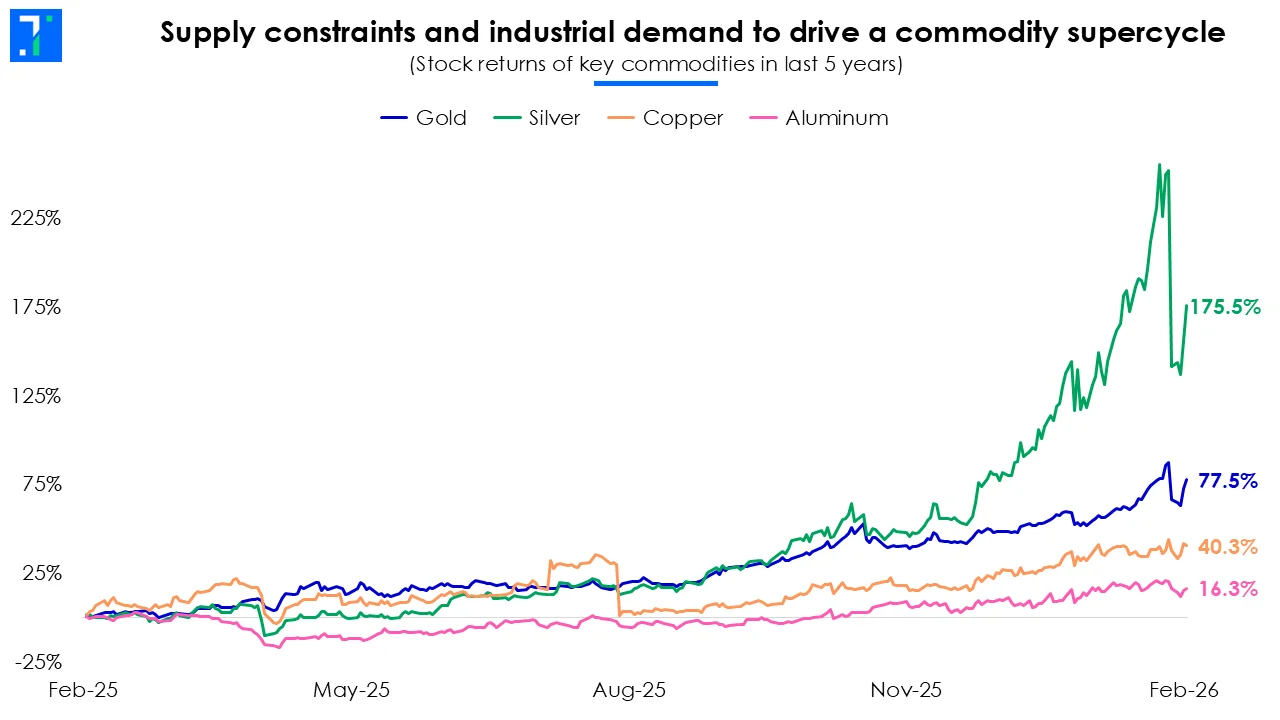
    Unlike past cycles, this move is not driven by speculation alone, but is anchored in physical demand.

    These metals sit at the core of electrification. AI data centers, power grids, electric vehicles, and renewable energy systems all require large quantities of copper and aluminum, while silver plays a critical role in advanced electronics. “Silver is the world’s best electrical conductor. High-speed connections in computers, smartphones, AI systems and data centers depend on it,” said Pan American Silver CEO Michael Steinmann.

    Supply is struggling to respond. High energy costs and environmental regulations cap smelter output in China and Europe. Aging mines in Chile and Peru face declining ore grades, forcing miners to process far more rock to produce the same output as two decades ago.

    New supply takes time. A copper mine typically takes 15–20 years to reach production. Even at current prices, many greenfield projects fail to clear return thresholds. Most producers focus instead on incremental expansions at existing sites, and those additions remain limited.
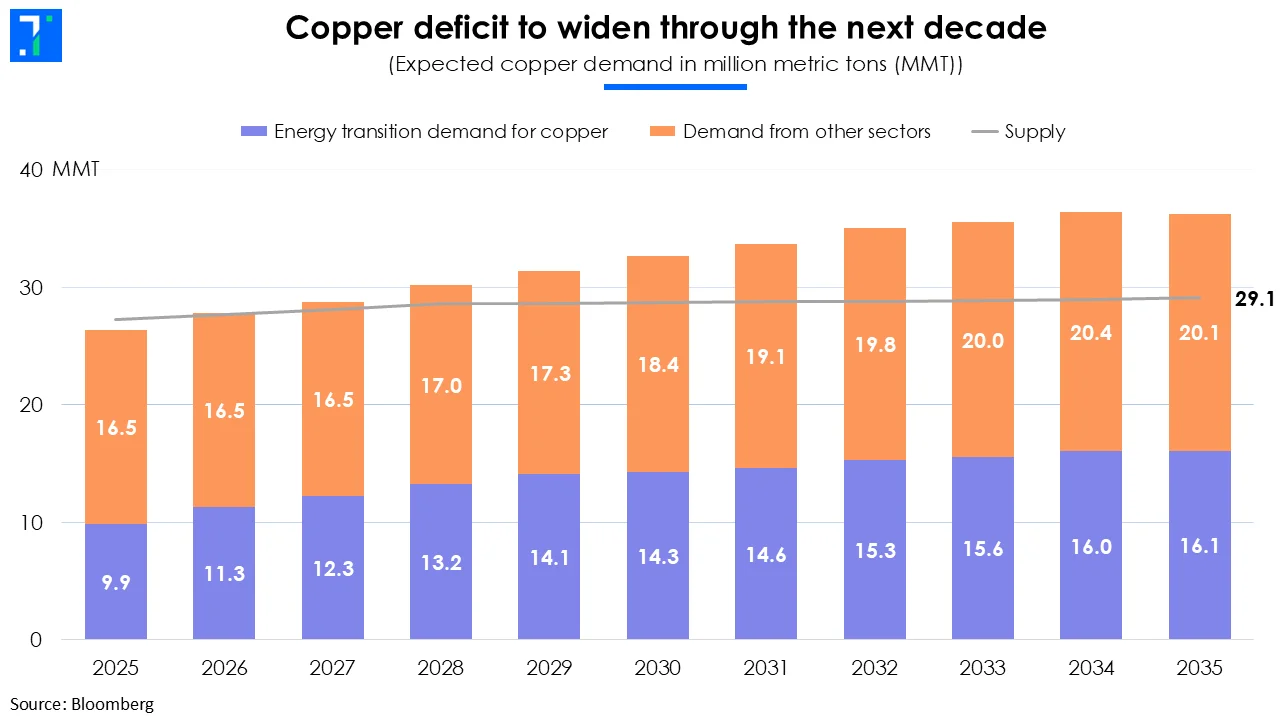
    Demand, meanwhile, keeps accelerating. Global electricity consumption is projected to rise by around 50% over the next decade, driving copper and silver use across power generation, transmission, and storage. The International Copper Study Group (ICSG) forecasts the refined copper market swinging to a deficit of 150,000 metric tons in 2026 from the previously expected surplus of 209,000 tons.

    To satisfy this demand, Robert Friedland, Founder of a Canadian mining company, says, ”We have to mine the same amount of copper in the next 18 years as we mined in the last 10,000 years combined to maintain 3% GDP growth.”

    Producers with scale stand to benefit most. Freeport-McMoRan and Southern Copper offer direct leverage to higher copper prices through long-life assets. In aluminum, Alcoa benefits from higher domestic pricing as tariffs raise import costs.

    Taken together, these forces point to a fundamental revaluation of the mining sector. If this is a supercycle, it is not because commodities have become fashionable, but a shift forced by the world relearning an old truth: the digital economy still runs on physical resources, and those resources are finite.

    Copy LinkShare onShare on Share on Share on
     
    logo
    The Baseline US
    22 Jan 2026
    Messy global politics is happy news for one industry: defense

    Messy global politics is happy news for one industry: defense

    Let’s be real. The current geopolitical chaos signals sunny days for the defense industry.

    Companies got ready to pop the champagne when US President Donald Trump said the United States should set its military budget for 2027 at $1.5 trillion, 66% higher than 2026 levels. This increase, he argued, was necessary to build what he called a “Dream Military” (led by the Secretary of War and former Fox News host Pete Hegseth).

    The budget hike will help the US fund the “Golden Dome” missile system alongside other plans. The Trump administration initially projected $175 billion in cost for the Golden Dome over three years to get it operational. The Congressional Budget Office pegged costs at upto $542 billion over 20 years to add elements like space-based interceptors.

    Then there's Greenland. Treasury Secretary Scott Bessent didn't mince words at Davos, calling Greenland “strategically important for the Golden Dome project to protect the US.” He insisted that “US control of Greenland stops kinetic war before it starts.”

    Defense Tweet

    As these dramas unfold, it is clear that the US defense industry is going to thrive, thanks to the influx of money and Trump's sabre rattling driving demand. The only question right now is whether the US defense industrial complex can deliver.

    I say this because today’s US defense industry isn’t like the one that helped win the Cold War.

    One key change is consolidation. There was a massive loss of competition in the sector during the “peace dividend” years of the 1990s. The late 1990s saw more than two dozen major firms merge into three behemoths, Boeing Co., Lockheed Martin Corp. and RTX Corp. That came in the wake of a 1993 Pentagon meeting dubbed the “Last Supper,” where CEOs of big defense companies were informed the government expected some of them to go out of business as defense spending wound down. Countless small firms disappeared.

    Prime defense contractors emerge as the biggest winners

    Today’s US defense sector, home to over 60,000 firms feeding the Pentagon's needs, is dominated by five heavyweights: Boeing, Lockheed Martin, RTX, Northrop Grumman and General Dynamics, which together snag nearly a third of all contracts.

    Last year, their stocks all climbed, but RTX stole the show with over 70% gains, outpacing its peers amid booming revenues. “Global demand is rising, especially in Europe,” one analyst noted, as RTX's Q3FY26 results showed 12% sales growth to $22.5 billion, powered by Patriot missiles and F135 engines.

    Lockheed grew sales 9% on record F-35 deliveries (191 in 2025), while General Dynamics posted 11% revenue growth driven by Gulfstream jet sales and submarine programs. Northrop Grumman posted 8% revenue growth, while Boeing’s defense unit grew 25%. Trump has been good for defense spending, both in the US and abroad.

    Defense Prices

    Sky-high order backlogs (signed contracts yet to be executed) are also providing years-long sales visibility, so a lot of future revenue is baked in. Lockheed Martin tops the list at a record $179 billion in order backlogs, fueled by F-35s and missile purchases. General Dynamics isn't far behind with over $110 billion - a nice, fat multi-year cushion.

    RTX sits at $103 billion, Northrop at $91 billion, and Boeing's defense unit at $76 billion. In a world of uncertain budgets, this mountain of backlog orders signifies continued good times ahead for defense CEOs.

    Order Backlogs

    No one's standing still—these firms are pouring cash into factories to keep up. Lockheed is "scaling F-35 lines aggressively," RTX is expanding missile and engine output, and Northrop is ramping up B-21 and space systems.

    General Dynamics is boosting submarine and tank production, while Boeing eyes BDS growth. "Capacity constraints are the new bottleneck," warned an industry briefing.

    Geopolitics and the Arctic: demand that doesn’t switch off

    Global defense spending has shifted from a reactive wartime response to a permanent priority. The wars in Ukraine and the Middle East, along with sustained US–China rivalry, have ended the old cycle of spending spikes followed by pullbacks. Governments are now investing continuously to deter future conflict.

    Defense Table

    After years of underinvestment, NATO is restocking fast. Members plan to lift defense spending to 5% of GDP by 2035—3.5% for core military needs and 1.5% for security infrastructure. US systems are preferred because they integrate easily with existing NATO platforms.

    Kathy Warden, CEO of Northrop Grumman, pointed to the company’s 1.17 book-to-bill ratio, which indicate that new order intake is outpacing deliveries. She said, “The company’s portfolio is aligned with NATO’s new spending priorities, including the 1.5% allocation for security infrastructure.”

    That relationship, however, is not risk-free. Trump’s aggressive push to acquire Greenland highlights how political ambitions can quickly spill into concerns in Europe around buying weapons from US companies.

    Stratfor warns that “a coercive US military move on Greenland would accelerate European rearmament and strategic decoupling,” pushing European governments to favor domestic suppliers over US defense firms.

    President Trump pushes for major reforms

    The US defense budget for FY2026, signed into law by President Trump on December 18, 2025, totals approximately $901 billion through the National Defense Authorization Act (NDAA). This is expected to surge by another half a trillion dollars if Trump’s $1.5 trillion defense budget is approved.

    Defense Budget

    However, near-term sentiment deteriorated on January 7, 2026, when defense stocks plummeted 5-8% in a single session. This was triggered by President Trump's surprise executive order banning stock buybacks and dividends for contractors failing delivery timelines.

    RTX shares cratered 8.2% after Trump's Truth Social post singled them out:"Raytheon must refrain from any further stock buybacks until they rectify their practices", sparking panic over the "Prioritizing the Warfighter" EO's immediate enforcement on delayed Patriot missile and F135 engine programs.

    The broader sector selloff deepened as analysts warned of capped executive pay and forced factory reinvestments, with Lockheed (-6.1%) and Northrop (-5.9%) hit hardest amid Golden Dome prototype delays.

    On the positive side for private players, the Pentagon is trying something new: a partnership with L3Harris Technologies, where they will invest in the company’s missile unit with a $1 billion convertible preferred security. Creating a government stake could catalyze wider investment from private-sector actors, says Becca Wasser, defense lead for Bloomberg Economics.

    Analysts at Morgan Stanley maintain an "Overweight" rating on key players like General Dynamics and Northrop Grumman, citing the sheer scale of geopolitical events.

    As Tony Bancroft, a portfolio manager at Gabelli Funds, recently put it, the sector's resilience is "underpinned by long-term contracts and newly predictable revenue streams." We are entering a defense "supercycle", as political leaders globally worry about rising threats on land and sea. 

    Picture of the week

    Asher Perlman on a tipping culture gone haywire. 

    As always,
    The Trendlyne team

    Copy LinkShare onShare on Share on Share on
     
    logo
    The Baseline US
    08 Jan 2026
    From screws to superstars: memory chip makers are in the spotlight, thanks to AI

    From screws to superstars: memory chip makers are in the spotlight, thanks to AI

    For decades, memory chips were the unloved screws, the overlooked backbone of hardware technology: cheap, interchangeable, and easily forgotten. That era is coming to an end.

    “Memory bandwidth has become the key factor deciding whether a complex AI model succeeds or stalls,” say Citi analysts. And as AI ramps up in both hype and usefulness, memory chips are getting their moment in the sun. 

    Memory chips provide the working environment that allows processors from Nvidia to Intel to perform calculations. They are the digital heart of everything from hyperscale data centers and cars, to smartphones and household appliances. Now, artificial intelligence has turned them into a major choke point.

    The warning signs are everywhere. Samsung Co-CEO TM Roh said, “No company is immune to memory shortages, including mobile phones, TVs, and other consumer electronics.”

    Memory Chip Tweet

    Dell Technologies and HP have flagged potential memory shortages in the coming year, as AI infrastructure spending accelerates. Counterpoint Research expects memory module prices to jump as much as 50% by mid-2026. Lenovo has begun stockpiling memory chips to get ahead of rising costs.

    The supply crunch comes down to a specific culprit, High-Bandwidth Memory (HBM). These specialized chips sit right next to AI processors and determine how fast a system can learn and scale.

    Supply right now is incredibly tight. Only three companies on earth manufacture HBM chips at scale. All of them are operating near full capacity, leaving no room for error.

    HBM supply stays tight, with only three players

    There used to be more companies in the HBM space. But famously, even Intel, which invented the modern memory industry, and companies in Taiwan, the epicenter of leading chip production, gave up due to the capital-intensive nature of the business and razor-thin margins in the past.

    Memory chips market share

    Micron Technology is now the only US-based manufacturer with meaningful exposure to HBM, supplying advanced HBM3 and HBM3E chips used in AI accelerators. Thanks to soaring demand, Micron has transformed from a company struggling with excess inventory, to a critical AI linchpin. 

    The firm has seen gross margins improve by over 15 percentage points over the past year. Profits recovered meaningfully in 2025, with multi-year customer contracts. This turnaround has propelled Micron’s stock to more than triple over the past year.

    Memory chips price action


    Globally, the center of gravity for memory chips sits in South Korea. SK Hynix emerged as the market leader after investing early, and aligning closely with Nvidia’s accelerator roadmap. That first-mover advantage translated into a 274% share price surge in 2025, as AI demand absorbed nearly all its available supply. Samsung Electronics, despite execution challenges and slower customer approval, also delivered around 125% gains over the same period.

    AI is crowding out your electronic devices

    Factories are now prioritizing these high-speed, complex HBM chips for AI. Because these are harder to make, they are cannibalizing the production capacity for lower-end memory used in smartphones and laptops. Micron CEO Sanjay Mehrotra says memory markets “could remain tight past 2026,” as AI demand keeps production diverted to high-end chips.

    Japanese electronics retailers have already begun limiting the number of hard-disk drives customers can buy. Chinese smartphone makers are warning consumers of imminent price hikes. Meanwhile, tech giants including Microsoft, Google, and ByteDance are racing to lock in long-term contracts for memory chips.

    DRAM, a type of high-speed memory chip that temporarily stores data for computers and AI processors, is in short supply. Inventories have dropped about 80% from last year, leaving only three weeks of stock, as AI data centre demand uses most of the capacity.

    Memory chips shortage

    A prolonged chip shortage could slow AI-driven productivity gains and delay hundreds of billions in planned digital infrastructure. “The memory shortage has now become a macroeconomic risk,” said Sanchit Vir Gogia, CEO of Greyhound Research. The global AI build-out, he warns, “is colliding with a supply chain that cannot meet its physical requirements.”

    A $400 billion supercycle

    The global memory market is in a high growth phase, and industry forecasts project annual growth of over 12% through 2030, driven by AI workloads, cloud data centers, and high-performance computing. The global memory chip market could triple from $125 billion in 2024 to nearly $400 billion by 2034.

    Memory chips market size

    New factories take years to build, even as memory chip manufacturers are speeding up their timelines. SK Hynix is building a $3.9 billion facility in West Lafayette, Indiana. By 2028, SK Hynix expects to ship finished HBM stacks directly to US AI accelerator assembly lines. But that's two years away.

    Backed by US CHIPS Act incentives, Micron has lifted FY26 capital spending to $20 billion, a 45% YoY increase, with most of that directed toward HBM. But Micron’s new chip factories in Idaho and New York are still years away.

    Similarly, Samsung Electronics plans to raise total HBM capacity by around 50% by the end of 2026, driven by expansion at its Pyeongtaek campus, the world’s largest semiconductor complex.

    These initiatives will not eliminate shortages overnight. Analysts from Morningstar and JP Morgan estimate that the ongoing “supercycle” might persist well into 2027. AI has permanently raised the memory content per server. This is a fundamental reset, and one that will benefit memory chip makers in the long term.

    Copy LinkShare onShare on Share on Share on
     
    logo
    The Baseline US
    23 Dec 2025
    Four trends that will shape the US stock market in 2026

    Four trends that will shape the US stock market in 2026

    The US stock market in 2025 was a season of plot twists and jump scares. In April, the S&P 500 index corrected by over 10% due to the Trump tariffs. By June, it ripped to fresh highs after President Donald Trump softened his stance and investors piled headfirst into anything even remotely AI-related. So far in 2025, the index is up by more than 17%, reaching a level of 6,878 by December 23. But more than half of those gains came from a few mega-cap giants worth $200 billion or more.

    This sets the stage for a very different 2026. According to David Kostin of Goldman Sachs, the easy phase is over. The era of rising multiples is ending, and the next leg of the bull market will lean less on hype and more on hard earnings growth.

    Not everyone is convinced returns will be exciting. Savita Subramanian of Bank of Americawarns that slowing share buybacks could cap S&P 500 gains at a modest 4% next year, with a target price of 7,100.

    Jean Boivin of BlackRocksays, "The market is moving from a policy-driven phase to a productivity-driven one." He suggests that as capital spending translate into results, the focus must move toward infrastructure.

    Let’s look at four trends that will shape 2026 returns.

    1. The AI bill comes due next year

    For the past three years, markets treated AI like a free lunch. Productivity gains were assumed, and valuations ran ahead of reality. By 2026, hyperscalers are expected to spend over $527 billion on capital expenditure, sharply higher than earlier estimates of $465 billion. The money is pouring into chips, data centers, and power-hungry infrastructure, to keep chatbots like ChatGPT, Gemini, and Claude running smoothly, and to make sure they’re ready to handle a (highly disruptive) shift of economic activity from humans to machines.

    The final bill may run into the trillions. The financing is coming from venture capital, debt and, lately, unconventional circular financing arrangements that have raised eyebrows on Wall Street.

    A flood of debt sales from Big Tech could weaken the credit market on both sides of the Atlantic. Wall Street underwriting to fund AI and data centers is soaring, but would-be creditors are starting to worry about being compensated for the risks of a bubble. Tech firms are expected to float as much as $1.5 trillion of debt by 2028.

    Morgan Stanley warns that this could push up borrowing costs as investors may demand higher returns to absorb the supply. KKR’s Raj Agrawal says, “Some of these investments are likely not going to work out, that’s just the reality when you have this much capital moving this fast.”

    The gap between infrastructure spending and revenue generation is increasingly visible. Many companies funded AI expansion with debt, introducing new balance-sheet risks. Debt-funded AI spending is widening the divide between leaders and laggards, pushing investors away from firms where capex growth is not matched by cash flow. This led Meta to shift its focus from open source models to money-making ones.

    1. Concentration risk rises as capital crowds into top companies

    Beneath the noise is a structural problem: extreme concentration. Investors have crowded into “one dominant stock per sector” in search of safety. Nvidia in semiconductors and Eli Lilly in healthcare are prime examples. While fundamentals remain strong, overcrowding amplifies downside risk due to expensive valuation compared to its peers.

    Dubravko Lakos-Bujas of JPMorgan says, “markets are becoming unbalanced, with too much money flowing into just a few popular stocks. When many investors pile into the same names, prices move more sharply." It also makes risk harder to manage, because in stressful periods, heavy selling can quickly push prices down.

    2025 was “Trump 1.0 on steroids,” said Keith Lerner, chief investment officer and chief market strategist at Truist Advisory Services Inc., adding that he can’t recall another period when US political decisions triggered this much market volatility.

    1. AI’s appetite for power is raising electricity costs

    The power bill shock isn’t over. As the US heads into 2026, electricity prices are moving higher. Throughout most of the year, US electricity bills rose faster than overall consumer prices. By September 2025, electricity bills were up 5.1% YoY, compared with a 3% rise in broader consumer inflation.

    Retail power rates jumped 7.4% in September 2025, pushing prices to a record 18.1 cents per unit, the steepest increase in nearly two years. With fuel costs climbing and demand staying firm, power bills for homes, transport and businesses are likely to rise further next year.

    Electricity demand is rising far faster in Texas and the Mid-Atlantic than the national average. While US power sales are expected to grow about 2.2% annually, Texas demand could jump around 11%, driven by data centres, factories and crypto mining, while PJM demand is set to rise 4% in 2026, led by Northern Virginia.

    Data center expansion is the primary driver. Global electricity consumption by data centers is projected to grow 17% through 2026. “AI’s surging power demand growth will be testing grid limits,” says Eduard Sala de Vedruna of S&P Global Energy. Utilities are being forced into large-scale infrastructure upgrades to meet this demand.

    1. Diversification beyond mega-cap firms

    The mega-cap firms now make up more than half of the S&P 500’s total value, a historic high. However, the market’s spotlight is shifting toward the “enablers” powering the AI boom. Industrial firms and semiconductor supply chains that provide copper, power equipment, cooling systems, and grid hardware are unglamorous but indispensable inputs to the AI and electrification buildout, and many still trade at far more reasonable valuations.

    As a result, leadership is expected to rotate toward cyclical and value-oriented sectors. Solita Marcelli of UBS says, "Financials and healthcare are providing a broad foundation as policy uncertainty fades." Mike Wilson of Morgan Stanley adds that investors should favor "industrials and real assets" to capitalize on a "run-it-hot" economy focused on domestic manufacturing.

    Semiconductor onshoring is driving a multi-year investment cycle. New US manufacturing plants are coming online, boosting demand for construction and engineering services. The push to make chips at home is driven by national security concerns flagged by the Trump administration. Because these factories are seen as critical infrastructure, spending is likely to continue even if the broader economy slows.

    Thanks to these shifts, Michael Wilson of Morgan Stanley expects “market breadth to improve” as leadership shifts toward Financials and Industrials, describing 2026 as an “early-cycle” bull phase for the broader index.

    The next phase of returns may favor companies solving physical bottlenecks. Power, cooling, and grid infrastructure providers are gaining attention. Denise Chisholm of Fidelity notes that “rotation and small caps” could outperform as leadership widens. In this environment, diversification is no longer just protection, but a source of opportunity.

    The transition from 2025 to 2026 marks the end of the "imagination phase" of the AI bull market and the beginning of the "execution phase." While the previous year was defined by geopolitical plot twists and a narrow chase for mega-cap safety, the coming year will demand a different approach.

    Copy LinkShare onShare on Share on Share on
     
    logo
    The Baseline US
    16 Dec 2025
    ‘Jenga tower’ US economy is in danger, as the middle class pulls back

    ‘Jenga tower’ US economy is in danger, as the middle class pulls back

    Talk of a “K-shaped” economy is trending again.

    The term first gained momentum in 2020, when the pandemic exposed how unevenly American prosperity was distributed. Today, with spending power even more concentrated at the top, economists warn that the US economy is becoming dangerously top-heavy.

    For many Americans, the economy looks strong on paper, but feels fragile in daily life. Jobs are less secure, while big ticket items like housing are much more expensive. One image captures the risk well: a Jenga tower. From afar, a Jenga tower economy looks impressive, rising quarter after quarter. But look closely at the base, and you see blocks being pulled out and stacked on top. So the taller the tower grows, the less stable it becomes.

    Recent data reflects this. GDP growth in Q2 was the fastest in nearly two years. “The US will finish the year with 3% real GDP growth, despite the lengthy government shutdown,” Treasury Secretary Scott Bessent bragged in an interview with CBS. But the Fed’s latest 25 basis point rate cut, prompted by weakening labor-market data, suggests that things are unstable below the surface. A big chunk of the growth was driven by large tech players like Nvidia, and consumer spending was fuelled by high income consumers. 

    Mark Zandi, chief economist at Moody’s Analytics, warns that such concentrated spending power creates a single point of failure. “It makes the economy very vulnerable, if anything goes off the rails for these high-income, high-net-worth households.”

    This has now become a political issue. "Affordability" dominated campaign messaging in recent elections, helping Democrats win easily in New York City, New Jersey, and Virginia. Voters are not looking at GDP charts. They are looking at grocery bills, rent hikes and job insecurity.

    So how long can a top-heavy economy can keep rising before the tower starts to wobble?

    The top 10% now drive consumer spending

    Companies have been watching this income divide play out. Krogernoted in September that low and middle-income shoppers are relying more on coupons, switching to store brands, and cutting back on dining out. Procter & Gamble reported a similar pattern in their data: households living paycheck to paycheck are chasing discounts, while affluent consumers continue to buy in bulk without hesitation.

    High-income Americans, the top 10%, now account for about half of all US consumer spending. In the early 1990s, that figure was closer to one-third.

    This imbalance has been decades in the making. These wealthier households, supported by rising stock portfolios and higher home values, are spending freely. Lower-income consumers are pulling back as inflation eats away at purchasing power, and a cooling job market leaves them exposed.

    Over the past year, food prices rose 3.1%. Energy costs increased 2.8%, with natural gas up 11.7% and electricity up 5.1%. Shelter costs climbed 3.6%, and medical care rose 3.3%.

    As a result, more Americans are slipping into the lower leg of the “K,” and are struggling to keep up with basic expenses.

    As this divide deepens, Gen Z is responding differently. Unlike earlier generations that usually waited until their 30s to invest, many young adults are entering stock markets early. Easy-to-use trading apps, greater access to financial education, and the need to build wealth outside traditional career paths are driving the shift. Surveys showa growing share of Gen Z investing before age 25, as their wages lag behind rising asset prices.

    The labor market is flashing warning signs

    Fresh labor data reinforces the strain consumers are talking about. ADP data shows that private employers shed 32,000 jobs in November, far below expectations for a gain of 40,000. The losses were broad-based, but small businesses were hit hardest. Firms with fewer than 50 employees cut 120,000 jobs, reflecting limited ability to absorb higher costs tied to inflation, utilities, and tariffs.

    Job openings in October remained elevated at about 7.7 million but showed little change from the previous month. Layoffs rose to their highest level in nearly three years, while the share of workers quitting voluntarily declined. The drop in voluntary quits suggests growing uncertainty about finding better opportunities.

    Wage trends also point to cooling momentum. Pay and benefits are rising more slowly. While compensation gains still exceed inflation, the gap is becoming smaller, which means that employers now have more power in negotiating wages.

    This leaves the Fed in a difficult position. Growth and unemployment look stable on the surface, but policymakers have delivered a third rate cut as signs of weakness accumulate, particularly in white-collar jobs. Fed Chair Jerome Powell has cautioned that employment data may be "overstating the numbers", with internal estimates suggesting monthly job gains could be inflated by as much as 60,000.

    Consumer sentiment has held up

    Despite these pressures, parts of the economy are showing more strength than expected. High-end spending is strong, and real-time card data says that demand is holding up among wealthier consumers.

    US consumer sentiment rose in December for the first time in five months. The University of Michigan’s preliminary sentiment index climbed to 53.3, up from 51 in November, as inflation expectations eased. Surveys conducted later in November captured a rebound in confidence following the end of the government shutdown, which had weighed on household mood.

    Corporate earnings tell a similar story. Retailers who focused on shoppers with fat wallets, are outperforming. Macy’s CEO Tony Spring noted that Bloomingdale’s posted 9% year-over-year sales growth in Q3, driven by consumers willing to spend.

    The holiday season reinforced this trend. Adobe Analytics data showed record online sales of $11.8 billion on Black Friday, up more than 9% from last year. Cyber Monday sales reached $14.3 billion, a 7.1% increase.

    Shoppers gravitated toward electronics, apparel, and home goods. But they were also often using buy-now-pay-later options to stretch budgets. 

    Will the tower keep rising? 

    Looking ahead, the main risk lies with high-income consumers, who now drive much of the overall demand. Their confidence depends heavily on rising stock prices. Strong gains in the S&P 500 boost household wealth and encourage spending, but that support remains fragile. Economists at Oxford Economics note that moves in stocks and other financial assets now shape how consumers view their own future and how much they spend. If overheated tech stocks cool, or markets turn volatile, spending can slow down fast. 

    The economy still looks strong from a distance, and for many at the top, it genuinely is. But strength built on concentration is brittle. As spending power narrows, the tower grows taller and the margin for error shrinks. The end of a Jenga game rarely comes with a warning. A tower can rise for a long time before gravity reasserts itself.

    Copy LinkShare onShare on Share on Share on
     
    logo
    The Baseline US
    30 Nov 2025
    The magic weight loss pill that could rewrite the anti-obesity market

    The magic weight loss pill that could rewrite the anti-obesity market

    We’re right on schedule for post-Thanksgiving regret — when you ask yourself if you really needed to reload your plate with food for the third time. Eating like it’s a competitive sport felt great in the moment. What’s a few pounds when the mashed potatoes and gravy were that good?

    But Susan, who’s been on semaglutide for more than six months, had a very different Thanksgiving. The drug’s active ingredient suppressed her hunger, made her feel full. “I stared at a plate of stuffing and didn’t feel the usual urge to dive in,” she said.

    That ability — to turn someone away from a delicious dish against all odds — is reshaping the stock market for GLP drug manufacturers. Drug maker Eli Lilly for example, has seen its stock price surgenearly 40% over the past year, and cracked the trillion-dollar club.

    But the original pioneer, Novo Nordisk, maker of Ozempic and for a brief time, Europe’s most valuable company, saw its valuation drop by more than 50% last year. It took another hit after its Phase 3 Alzheimer’s trials failed.

    The winner in this market is changing fast. Even with the current Lilly–Novo duopoly, the anti-obesity market is getting more competitive, with pricing fights, new formats, and a innovation race that is changing who stays on top.


    What’s driving the trillion-dollar rally?

    OnNovember 21, 2025, Eli Lilly became the first healthcare company to reach a $1 trillion market cap. Analysts don't see this as a peak — it is just confirmation that Lilly now leads the obesity market, and is going to keep soaring.

    Morgan Stanley raised its price target for Lilly by another 10% to $1,290, arguing that the weight-loss drug boom is still in its early innings. With supply bottlenecks easing, Morgan Stanley models show sales continuing to beat expectations.

    Bank of America and Truist Securities echo that view, crediting Lilly's massive new investments in manufacturing capacity. Put simply, Lilly can now supply weight loss drugs at a level that competitors can’t match. That advantage is showing up in the numbers.

    Lilly's Zepbound Q3 sales nearly tripled to $3.6 billion, overtaking Wegovy’s $3.1 billion, which grew only 18% YoY. Analysts expect Zepbound to pull decisively ahead of Wegovy, with an even bigger lead in 2026.

    A big part of the momentum comes from patient experience. Data from drugs.comshows Zepbound outperforming Wegovy across every major category. It delivers higher weight loss with better tolerability: nausea hits 31% of Wegovy users versus 25% of Zepbound users.


    The oral revolution

    The next battleground is clear: who launches the first, blockbuster weight-loss pill. Pills are cheaper to make, easier to store, and far more convenient than today’s injectable pens, which still face supply shortages.

    Analysts expect a big shift from injections to daily pills by the end of the decade. Goldman Sachs has already adjusted its outlook: after factoring in expected price cuts for injectables once pills arrive, it now pegs the global anti-obesity market at $95B by 2030 (down from $130B).

    Looking further ahead, Goldman sees a $120B peak by 2033, with $70B coming from the U.S. and $50B from international markets.

    At the center of Wall Street’s optimism is Eli Lilly’s pill candidate, Orforglipron. The one-a-day pill has cleared Phase 3 and is expected to launch in 2026. Trials show patients losing around 15% of body weight over 36 weeks.

    Its edge lies in chemistry. Unlike fragile, peptide-based injectables, Orforglipron is a small-molecule drug — meaning it can be mass-produced in standard chemical plants, just like statins or Tylenol. If approved, it could ease global supply pressure almost immediately.

    The pill is also simpler for users: no fasting windows, no water rules, and you can take it with coffee. Weight loss (10–14.7%) is a touch lower than injectables, but convenience and scalability make it attractive. Side effects are similar to the injection: mild-to-moderate nausea, diarrhea and constipation.

    Novo Nordisk’s planned pill is more effective but also higher friction. It's not a new compound, but just high-dose oral semaglutide. It is essentially “Wegovy in pill form” — which delivers 15–17% weight loss but requires an empty stomach, minimal water, and a 30-minute wait before eating to protect the peptide from digestion.

    Everyone wants a piece of the pie

    As Lilly and Novo plan to launch their pills by 2026, a second wave of biotech challengers is lining up behind them. AMGEN, Viking Therapeutics and Roche are all advancing weight-loss efforts, hoping to break the Lilly-Novo duopoly by 2027.

    “Investors clearly prefer Lilly over Novo in the obesity-drug arms race,” said Evan Seigerman of BMO Capital Markets. “But that premium also leaves Lilly exposed to a big downside, if any pipeline drug disappoints.”

    By contrast, other companies, which are trading at lower valuations face less downside and more upside if their bets work.

    And there's more competition coming. One of the biggest news stories in late 2025 was Pfizer’s re-entry into the obesity space through its acquisition of Metsera. Novo reportedly tried to block the deal with a surprise $9B offer, forcing Pfizer to raise its Metsera bid to $10B.

    Why the urgency from Novo? Because Metsera owns what analysts call the industry’s “crown jewel”: MET-097i, a once-monthly GLP-1 injection. Pfizer is betting that if the choice is between 52 injections a year or 12, the winner is obvious.

    Analysts say the scramble underscores just how competitive this market is about to get. One put it simply: “As the GLP-1 race widens, companies aren’t just fighting for market share anymore; they’re fighting for staying power.”

    As always,

    The Trendlyne team

    Copy LinkShare onShare on Share on Share on
     
    logo
    The Baseline US
    17 Nov 2025
     Markets are hitting the high notes, but the band looks a bit nervous

    Markets are hitting the high notes, but the band looks a bit nervous

    Plenty of CEOs are feeling at the top of the world this earnings season. One can expect the bar bills at Kokkari and Nobu to skyrocket as they celebrate. Of the 90% of listed companies that have reported results for the quarter, over 80% have beaten consensus earnings estimates. Most US indices, led by this positive momentum, soared to new all-time highs.

    So why is sentiment so wobbly? Despite all the good news, the folks paid to analyze these companies are not exactly popping the champagne. A Citigroup index that tracks whether analysts are upgrading or downgrading their earnings estimates is barely in positive territory, sitting at just 0.15.

    This index is considered a leading indicator for shifts in corporate earnings. Its weakness indicates analysts don't think that the good news will last, or that its broad enough to translate into meaningfully higher profitsin the near future. The vibes are not great. 

    Take AMD, for instance. Its Q3 numbers came in ahead of estimates, and its Q4 outlook also beat the consensus. But the stock still tanked by over 3% on results day and has been trending downward since. It’s the same story for Palantir, Uber, and a long list of other tech darlings.

    As Bloomberg analysts point out, the problem wasn't that the outlook was bad per se—it's that it wasn't spectacularly, unbelievably good. The outlook didn't clear the “most optimistic of estimates.”

    This is the classic sign of a stock “priced to perfection.” The market has already baked in every possible piece of good news, and believed everything promised by top management. Now anything less than a miracle is a disappointment. This is the theme for just about every AI flagbearer.

    As an investor, you must be thinking about what you should do at this moment. Michael Burry says,

    “Sometimes, the only winning move is not to play.”

    Interestingly, the photo Burry posted with this quote was not of himself, but of movie star Christian Bale, who played him in the film The Big Short. Has Burry bought into his own mythology, and is unwisely betting against market wisdom with his AI short? Or is the bubble really ready to burst?

    The problem with pessimism

    The investor and cofounder of Merrill Lynch, Charles Merrill, was worried about over-valuation and speculation in the 1929 stock market. He pulled all his funds out early that year, and warned other investors. But the stock market continued to rise by another 90% before it finally collapsed. The problem with being the pessimist in the room, is that people can hold on to their beliefs much longer than you think, against all evidence.

    This time around, many investors are echoing Burry's warnings. Berkshire Hathaway's cash pile is rising every quarter. It now stands at a staggering $380 billion. When one of the world's most successful investors is hoarding cash instead of buying stocks, it pays to ask why.

    Bubble, bubble, toil and trouble: the hype train has led to sky-high valuations

    Why is everything so expensive if the smart money is on the sidelines? In a word: AI.

    The argument that drove the spike in AI valuations, is that AI will contribute up to $15.7 trillion to global GDP by 2030, where $6.6 trillion would be from productivity gains and $9.1 trillion from increased consumption.

    AI company CEOs like Sam Altman also talked up the prospect of Artificial General Intelligence coming at the end of the year (a promise that got advanced by another year at the start of every new year).

    This optimism lit a fire under AI-tracking ETFs (like the Global X Artificial Intelligence Technology ETF and the iShares Future AI & Tech ETF), which are trading at an annual gain of around 30%. This frenzy has pushed the whole market into nosebleed territory with the S&P 500 trading at a P/E of 28, while the Nasdaq 100 index trades at a P/E of 37. Both indices are at record highs after surging more than 14% this year.

    Not everyone is sounding the alarm. Robert Edwards, chief investment officer at Edwards Asset Management, said that he thinks big tech stocks still have “gas left in the tank.” But even he added, somewhat weakly, that it is “time for a rotation into other parts of the market.”

    Interestingly, the Russell 2000 (a small-cap index) has gained nearly as much as the S&P 500 from its April lows. Analysts attribute this to speculative and momentum bets, as more than 40% of the small-cap index's constituents are loss-making firms. Meanwhile, the S&P Midcap 400 is trading at a gain of 3% year-to-date.

    Value is getting harder to find

    Legendary investor Howard Marks of Oaktree Capital notes that every time the S&P 500 has traded at a forward P/E above 23 (think the dot-com peak or the 2021 highs), the next decade for investors has been miserable. We're talking average annualized returns of just 2-3%.

    The reason is that when valuations are this high, there's no room for them to go higher. You are completely dependent on earnings growth that, historically, almost never lives up to the hype.

    It’s a stark reminder that investing at the right valuation is just as important—and maybe more important—than investing in a good company.

    So, where is the value now? It's pretty scarce.

    Trendlyne’s valuation score checks if a stock is competitively priced based on its P/E, P/BV, and share price, among other metrics. A score over 50 is a good initial filter for value. 

    Right now, less than 12% of all listed stocks in the US market have a valuation score above 50.

    Check out this screener to filter all the value stocks based on Trendlyne’s valuation score. You can also edit the query to make the criteria more stringent or more relaxed, as you like.

    Finding the unicorns

    That 12% figure—that only about one-tenth of the market is “at value”—tells you just how overstretched things are. The other problem is that a “cheap” stock in this market isn't necessarily a “good” stock. A lot of stocks are cheap for a reason!

    To find real opportunities, you need to find the (rare) combination of all three:

    • Durability: A solid business with stable revenues, profits, low debt, and good cash flow. (Right now, over 900 stocks have a Durability score above 55).
    • Momentum: The stock is actually in an uptrend and showing buyer demand. (Over 1,110 stocks have a Momentum score above 60).
    • Valuation: It's not crazy expensive.

    How many stocks in the entire market have all three? Trendlyne’s Strong Performers screener filters for exactly this: high durability, good valuation, and strong momentum.

    The result? Less than 90 stocks.

    That’s it. Less than 2% of all US stocks. That's how rare it is to find a high-quality, fairly-priced company these days, that also has the wind at its back. A few of the names that currently make the cut include Leidos Holdings, Western Digital, Great Lakes Dredge & Dock Corp., Enersys, and Invesco.

    Do check out the screener at Trendlyne to make more such filters of your own.

    Copy LinkShare onShare on Share on Share on
     
    logo
    The Baseline US
    31 Oct 2025
    Analyst picks: Earnings beats meet AI momentum, driving a rally

    Analyst picks: Earnings beats meet AI momentum, driving a rally

    Wall Street is breathing easier.

    Even as the market rally cools, this earnings season is delivering some happy surprises, with 85% of S&P 500 companies beating profit estimates -- the best showing in over four years.

    The results suggest that corporate earnings have held up despite a shaky world economy, tariffs and inflation.

    The good news isn’t confined to Big Tech.

    • Finance giants aced their results, as Citigroup and Morgan Stanley both beat revenue estimates by 4.3% and 9.3%.

    • The industrial sector also got a lift. General Motors raised its profit guidance by 11%, fueled by robust truck sales and tariff relief.

    • Even consumer spending has held up. Coca-Cola outperformed, showing that consumers are still spending despite higher prices.

    JPMorgan Chase analysts summed it up:

    “US companies should continue to deliver superior earnings growth supported by a robust AI cycle, ongoing deficit spending, and a resilient consumer.”

    AI momentum pushes S&P 500 to record highs

    No surprise here: AI remains the market’s heartbeat.

    Goldman Sachs expects this rally to broaden further beyond Big Tech, and to midcaps and smallcaps, thanks to earnings strength and upcoming interest rate cuts. We look at three promising players in large, mid and smallcaps.

    AI hyperscalers help drive S&P 500 YTD gains to over 15%

    Right now, Nvidia is the market’s sun — when it shines, everything rises. Its immense influence explains why all eyes are on its upcoming results. Analysts forecastQ3 revenue growth of 56% and see EPS up 53% YoY, driven by still-unmatched leadership in GPUs and enterprise AI partnerships.

    “Nvidia is well-positioned to extend its rally into 2026 and beyond,” notes UBS.

    But there are also other S&P stocks seeing double-digit growth.

    Three S&P 500 stocks have double-digit revenue & EPS growth forecasts
    • Advanced Micro Devices (AMD) is projecting strong performance for its Q3 2025 earnings, thanks to data center and processor demand. The company has guided for quarterly revenue in the range of $8.4-9 billion. Analysts echo this optimism, forecasting a 40% increase in EPS.

    • Analysts forecast 70% EPS and 50% revenue growth YoY to $1.1 billion for Palantir Technologies. This is being fueled by the overwhelming adoption of its AI Platform (AIP).

    However, some analysts warn that Palantir's valuations are stretched. RBC calls Palantir “the most expensive name in our software coverage.”  It says the current valuation “looks unsustainable” without a significant earnings beat and raised guidance.

    Quiet Winners: Three midcaps set to outperform in the long run

    The AI wave isn’t just lifting the giants, it’s boosting midcap stocks too. Over the long term, midcaps have outperformed large caps by a wide margin, and this trend seems set to continue.

    S&P MidCap 400 index outperforms S&P 500 in the long run

    In the AI gold rush, it's midcap companies providing critical "picks and shovels" that are thriving, and Lumentum Holdings is a good example. This telecom equipment manufacturer stunned Wall Street by swinging to a profit in the last quarter, defying consensus estimates of a loss.

    This turnaround was led by demand from its cloud and networking segment, which accounts for the majority of its sales.

    Lumentum's new CEO, Michael Hurlston, said this was the direct result of the AI boom. Lumentum supplies the essential optical and photonic hardware, like advanced lasers, high-speed transceivers, and circuit switches, that enable the massive, energy-efficient data transmission required for intensive AI workloads. And thanks to the soaring demand from data centers, analysts expect the firm to report revenue growth of over 50% in Q1 and another profitable quarter.

    Three S&P MidCap 400 stocks across industries have strong revenue & EPS forecasts

    Duolingo, the go-to app for learning languages, continues to dominate with its playful, AI-powered learning model. The company raised its full-year guidance after an impressive first quarter.

    “We exceeded our own high expectations for bookings and revenue this quarter, while expanding profitability,” said CEO Luis von Ahn. Bookings jumped 84% in Q2, with monthly active users up 24% to 128.3 million. For Q3, revenue is expected to rise 35% YoY with EPS growth of 60%. Forecaster suggests that analysts remain bullish on the stock, with an average price target of $442, an upside of over 40%.

    The third company to watch: rising on the back of surging gold prices, Royal Gold doesn’t mine gold itself; rather, it finances miners in exchange for rights to buy a share of their output at discounted prices, a model known as streaming. This gives it steady profits without the risks of running a mine.

    With gold prices having topped $4,300, Royal Gold has enjoyed strong margins. Prices have cooled slightly as US-China tensions ease, but they’re still up more than 50% this year.

    The company reports Q3 results on November 5. Analysts expect revenue to be up 32% and EPS up 50% from a year ago.

    Smallcaps: hidden value in plain sight?

    Morningstar’s David Sekera sees small-caps "trading at a 16% discount to fair value, while large caps are at a premium.” Some stocks to watch?

    • Amentum, a global engineering leader, continues to grow on a $45B project backlog, and is expanding its nuclear and space projects as energy demand surges. With $5 trillion expected to flow into data centers, nuclear energy may be the only scalable, reliable power source to meet its needs.

    • Phibro, which focuses on animal nutrition and health, expects steady growth despite modest tariff pressures.

    • PJT Partners, a boutique investment bank, is riding a strong M&A rebound, with 29% EPS growth and the company seeing “the best M&A year in a decade.”  The firm has been on an “aggressive” hiring spree to prepare.

    Three S&P SmallCap 600 stocks across industries have strong revenue & EPS forecasts

    The market is walking a tightrope. So far, AI spending and earnings strength are offsetting inflation and macro stress. If the rally survives the 'bubble' narrative, the next phase may be broader than anyone expected.

    Copy LinkShare onShare on Share on Share on
     
    logo
    The Baseline US
    14 Oct 2025
    Past the AI hype, its billions in and billions out, with little profit

    Past the AI hype, its billions in and billions out, with little profit

    As the Dalai Lama might say, everyone is connected. OpenAI and AMD. OpenAI and NVIDIA. Oracle and OpenAI. NVIDIA and Oracle. Investor, customer, seller: in the AI ecosystem, these could be the same company.

    The big picture is that tech giants are investing billions into AI startups, which then use that money to buy the investors’ products—chips, cloud services, or infrastructure—looping cash back to the giants.

    A boomerang made out of money

    The most eye-catching move has been NVIDIA’s plan to invest up to $100 billion in OpenAI. The plot twist is that OpenAI will spend that money on NVIDIA chips. The cash exits NVIDIA’s left pocket and enters the right one.

    NVIDIA CFO Sarah Friar has openly admitted, “Most of this money will come back to NVIDIA.” If this deal plays out, it could be one of the largest single-company tech investments in history, one which cements NVIDIA’s role as the chip supplier at the heart of the AI boom.

    History rhymes, especially with startup bubbles. In the late 1990s, during the dot-com bubble, startups inflated their revenues by buying services from one another. It looked like growth, but the same dollar bills were being moved around, and profits were largely imaginary.

    Today, AI startups are following a similar circular pattern, but at an unprecedented scale.

    The web of billion-dollar deals

    Look closely, and you’ll see the same dotcom pattern across the AI ecosystem.

    Take Microsoft and OpenAI. Microsoft has poured over $13 billion into the startup. In return, OpenAI runs on Microsoft's Azure, and pays most of that cash back. Microsoft even takes 75% of OpenAI’s profits until its investment is repaid. The result? Analysts expect Microsoft to earn nearly $10 billion from OpenAI alone in 2025—almost 80% of its AI-related revenue.

    A wave of circular deals took place between tech giants and AI Startups

    Amazon has struck a similar deal with Anthropic. Its $8 billion investment is tied to Anthropic spending heavily on Amazon Web Services. AWS revenue from Anthropic could top $5 billion in the next year. For Amazon, the ‘investment’ is really a way to funnel billions of guaranteed sales into its own cloud arm.

    NVIDIA’s influence runs even deeper. Beyond its massive OpenAI deal, it holds a 7% stake in CoreWeave, a cloud provider. CoreWeave has already spent more than $7 billion on NVIDIA chips and has contracts worth $22 billion with OpenAI. That’s larger than the annual revenue of many Fortune 500 companies. So NVIDIA profits at every stage—chips sold directly, chips sold through CoreWeave, and as a shareholder in the buyers themselves.

    Oracle also plays a role in this loop. It has partnered with OpenAI to build massive data centers as part of the Stargate project. To run these facilities, Oracle will buy tens of billions of dollars’ worth of NVIDIA chips. This deal ties all three together—OpenAI, Oracle, and NVIDIA—creating another circular arrangement where investment, infrastructure, and hardware spending feed back into the tech giants.

    The circular economy of AI: Investments return as revenue

    These investments aren’t just financial bets. They are engineered loops where money doesn’t travel far—it spins inside a tight circle between the giants, each one feeding the other.

    Dazzling growth on balance sheets versus the sobering reality

    The growth numbers are eye-popping. OpenAI’s revenue jumped from $28 million in 2022 to $3.7 billion in 2024 and may reach $13 billion this year. Anthropic is projected to grow from $10 million to $5 billion in the same span. CoreWeave expects revenue to climb from $16 million to over $5 billion.

    AI startups sprint from millions to billions in revenue in just three years

    Valuations have surged alongside revenue. OpenAI is valued at around $500 billion now, while Anthropic’s valuation has more than doubled from March 2025 to September, reaching $183 billion. CoreWeave went public in March 2025 with a valuation of $23 billion and has since almost tripled to $71 billion.

    But none of these companies are profitable. Their chip and energy bills swallow up more than they earn. It’s like selling out a stadium but losing money on the fireworks. The customers of these AI companies aren't making money either — an MIT study found that 95% of companies saw no return on AI investments. Billions in, billions out, but profits are elusive.

    Hedge fund manager David Einhorn has warned that the sheer scale of this infrastructure spending may destroy huge amounts of capital. If the dot-com history repeats itself, these spectacular growth figures may turn out to be smoke and mirrors.

    The high-stakes gamble

    Despite the risks, the big players are betting on the long haul. OpenAI’s Sam Altman admits the hype may be running ahead of reality, but insists that AI’s long-term potential is worth the losses today. Microsoft, Amazon, Oracle, and NVIDIA share the same logic: control the tools and infrastructure now, and profits can come later.

    Regulators are less convinced. In January, the FTC began probing these mega-deals, worried they may crush competition. The inquiry has since gone quiet. 

    So for now, the AI Money-Go-Round keeps spinning—billions in, billions out, profits still missing. The trillion-dollar gamble could either reshape the global economy or leave a trail of wasted capital. The real suspense isn’t about how fast these companies can grow, but how long they can keep dancing before someone demands a profitable tune. When the music ends, there will likely be one winner, and many losers in the mix.

    Copy LinkShare onShare on Share on Share on
     
    more
    loading
    Trendlyne Logo Trendlyne
    Stay ahead of the market
    Quick Links
    • Contact us
    • Blogs
    • FAQs
    • All Features
    Markets Today
    • S&P today
    • Dow today
    • Latest Quarterly results
    Dashboard
    • Industry & Sector analysis
    • ETFs
    • Bullish & Bearish spread
    • Global Indices
    • Events Calendar
    Tools
    • Compare stocks
    • Widgets
    • Data Downloader
    • Excel Connect
    Company
    • Privacy
    • Terms of Use
    • Disclaimer
    Trendlyne Products
    • Starfolio
    • SmartOptions
    • Trendlyne India
    Get Mobile App
    • Android
    • iOS

    Copyright © 2026 Giskard Datatech Pvt Ltd (RA SEBI Reg No: INH000022507)